

Last updated: 2026-11-06
This page applies to the full framework: payment institutions, account information service providers and e-money institutions apply Articles 5 to 15 DORA, proportionately under Article 4 and with relief if they are microenterprises. The simplified framework under Article 16 is not available to them in Germany. Whether your institution is a microenterprise can be checked on the page DORA applicability.
DORA has applied to these institutions since 17 January 2025. This page is therefore about cleaning up existing documents: which documents from the ZAIT era have a new basis, which are still built on the old structure, and where is something missing that DORA requires in addition?
Why does Article 16 not apply to payment institutions?
Because Germany has not used the exemptions in the Payment Services Directive and the E-Money Directive. Article 16(1) names, among others, payment and e-money institutions exempted under these directives. There are no such institutions in Germany, so this group is empty here (BaFin supervisory notice of 21 August 2025, footnote 6). In the foreword, BaFin, the German financial supervisor, expressly names former ZAIT addressees as not covered. Article 16 is therefore not a size discount: even a payment institution with 14 employees, as in the example below, applies the full framework.
| Institution | DORA | Basis |
|---|---|---|
| payment institution | full framework under Articles 5 to 15, plus Articles 28 to 30, incident reporting and testing | Article 2(1)(b) DORA |
| account information service provider | full framework as above | Article 2(1)(c) DORA |
| e-money institution | full framework as above | Article 2(1)(d) DORA |
| institution that is a microenterprise | full framework with some relief, Articles 28 to 30 apply, with the relief below | Article 3(60) DORA |
The special rule under which Articles 28 to 30 do not apply to microenterprises is found in Section 1a(2a) of the German Banking Act (KWG) and only covers the group of institutions named there, the KWG group (DORA Article 16). It does not exist for payment and e-money institutions: even a small institution keeps a register of information and agrees the contract contents under Article 30.
What does full framework with proportionality mean?
You implement the same obligations as a larger bank, but to an extent that fits your size and risk. Article 4(1) requires Chapter II to be applied in line with size, overall risk profile and the nature, scale and complexity of the services, and RTS 2024/1774 specifies this in Article 1. Proportionality therefore changes how extensively an obligation is met, not whether it applies. DORA expressly requires less only from microenterprises, at these points:
| Obligation under the full framework | Rule | Microenterprises |
|---|---|---|
| ICT risk control function with an appropriate level of independence | Article 6(4) | not required |
| annual tests of all systems supporting critical or important functions | Article 24(6) | risk-based tests with strategic planning (Article 25(3)) |
| strategy on ICT third-party risk | Article 28(2) | not required |
| rights of access, inspection and audit in the contract | Article 30(3)(e) | may be delegated to an independent third party |
The table gives four examples. Further relief concerns, for example, the review of the framework, legacy systems and the crisis management function. Who counts as a microenterprise is set out on the page DORA applicability. The obligations matrix on the page DORA requirements marks the relief for microenterprises with (M).
What has become of the ZAIT?
It no longer applies. BaFin repealed the ZAIT (Circular 11/2021 (BA) as amended on 16 August 2021) together with the KAIT and VAIT at the end of 16 January 2025. In the sources we read, BaFin names no replacement document. According to its information letter of 19 December 2024, DORA essentially covers the previous IT requirements.
“Repealed” means: no express ZAIT requirement any more. DORA mostly still requires the tasks behind it, often in more detail.
The ZAIT had incorporated the EBA Guidelines on ICT and security risk management (BaFin names the predecessor version GL/2017/17). Their current version, EBA/GL/2019/04, has not been repealed. With EBA/GL/2025/02 the EBA narrowed them to the relationship with payment service users: for payment service providers within the scope of DORA, only section 3.8 remains alongside DORA, the other sections have been deleted. This version applies from 20 May 2025 at the latest, and according to the EBA compliance table BaFin applies it. For the ICT risk management framework itself, DORA is therefore the yardstick.
Where do the ZAIT chapters go?
Chapters 1 to 10 move into the full framework, RTS 2024/1774 and Articles 28 to 30, chapters 11 and 12 do not. BaFin has published a chapter-by-chapter comparison only for BAIT and VAIT. That it can “generally be transferred” to the ZAIT is stated in the foreword of the same supervisory notice of 8 July 2024 (our translation). The table applies it to the twelve ZAIT chapters. The mapping is ours, the numbered paragraphs (Tz.) come from the ZAIT. A mapping paragraph by paragraph is available as an Excel file for the BAIT on the page BAIT and DORA.
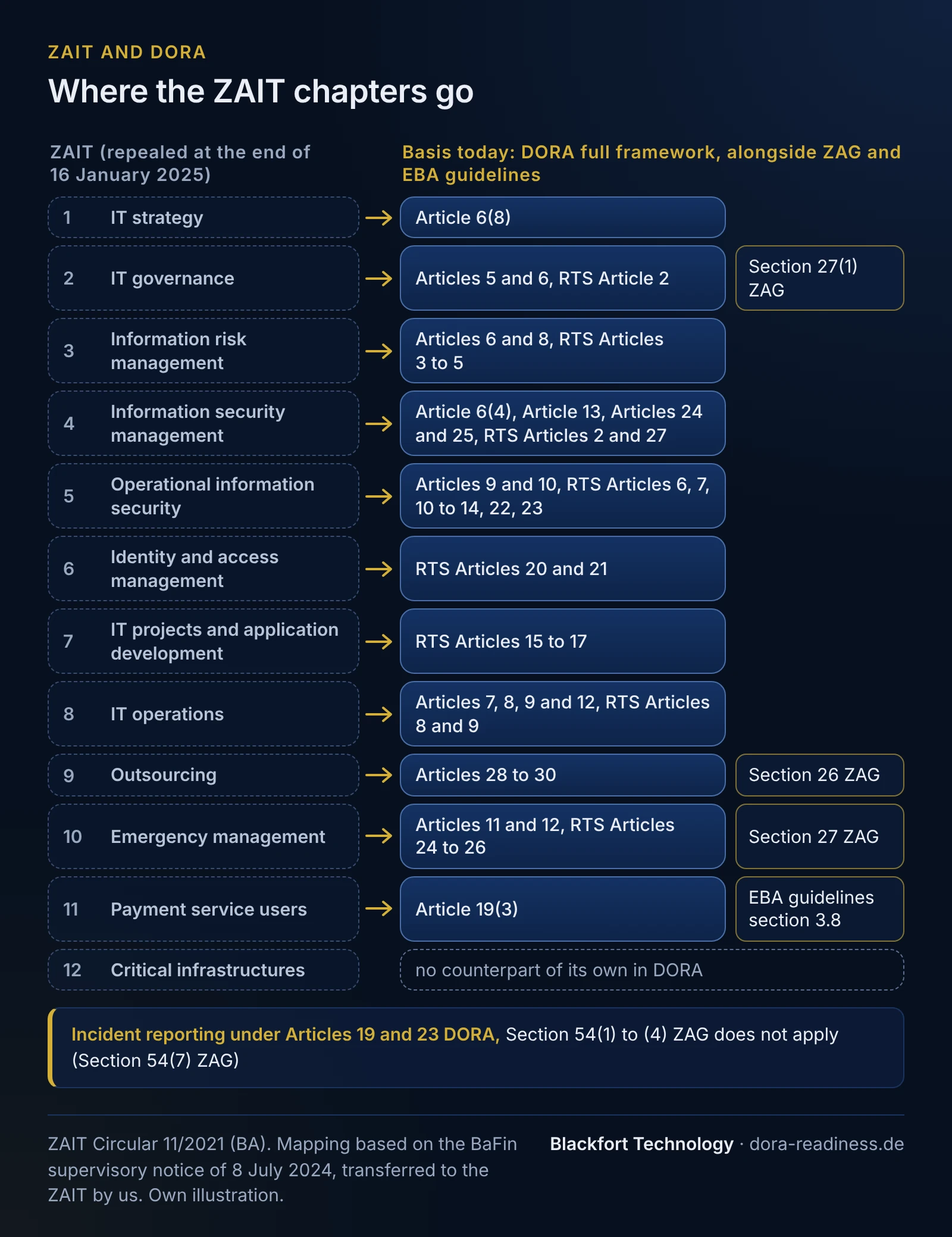
| ZAIT chapter (Tz.) | DORA and RTS 2024/1774 | What changes | What applies alongside |
|---|---|---|---|
| 1 IT strategy (1.1 to 1.5) | Article 6(8) | Instead of an IT strategy with minimum contents, a digital operational resilience strategy (DOR strategy) as part of the framework | - |
| 2 IT governance (2.1 to 2.9) | Articles 5 and 6, RTS Article 2 | The management body is responsible for the entire ICT risk management framework and undergoes regular training | organisational requirements under Section 27(1) ZAG |
| 3 Information risk management (3.1 to 3.11) | Articles 6 and 8, RTS Articles 3 to 5 | The protection requirements assessment becomes the classification of all ICT-supported business functions and assets, reviewed at least once a year | - |
| 4 Information security management (4.1 to 4.10) | Article 6(4), Article 13, Articles 24 and 25, RTS Articles 2 and 27 | According to BaFin, the ICT risk control function is similar to the information security officer but broader in scope. The testing policy (4.8) becomes the testing programme, awareness (4.9) becomes the training obligation for all staff | - |
| 5 Operational information security (5.1 to 5.6) | Articles 9 and 10, RTS Articles 6, 7, 10 to 14, 22, 23 | Much more detailed on network security, encryption, vulnerabilities and detection | - |
| 6 Identity and access management (6.1 to 6.8) | RTS Articles 20 and 21 | Express requirements on identity management and access control, need-to-use principle | - |
| 7 IT projects and application development (7.1 to 7.15) | RTS Articles 15 to 17 | Change management covers all changes to ICT systems | - |
| 8 IT operations (8.1 to 8.8) | Articles 7, 8, 9 and 12, RTS Articles 8 and 9 | Backup policy, restoration on systems that are physically and logically segregated from the source system | - |
| 9 Outsourcing and other external procurement of IT services (9.1 to 9.15) | Articles 28 to 30, Delegated Regulations (EU) 2024/1773 and 2025/532 | Covers every contractual arrangement on ICT services, with register of information and mandatory contents | Section 26 ZAG: outsourcing including ICT systems, outsourcing register, notification of material outsourcing |
| 10 Emergency management (10.1 to 10.9) | Articles 11 and 12, RTS Articles 24 to 26 | ICT business continuity policy, business impact analysis, response and recovery plans, tests at least once a year, recovery objectives per function, crisis management function | Section 27(1) sentence 2 no. 3 ZAG: adequate emergency concept for IT systems |
| 11 Managing relationships with payment service users (11.1 to 11.8) | Article 19(3) (informing clients about major incidents) | No DORA chapter of its own. Raising awareness among payment service users remains in the EBA guidelines | EBA/GL/2019/04, section 3.8 (paragraphs 92 to 98), alongside DORA since 2025 |
| 12 Critical infrastructures (12.1 to 12.5) | no counterpart of its own | Protective measures support the critical or important functions. Section 28(6) of the German BSI Act (BSIG) exempts financial entities under DORA from several BSIG obligations | distinction on the page DORA and NIS2 |
Chapter 11 deserves attention: section 3.8 of the EBA guidelines on the relationship with payment service users continues to apply to payment service providers and supplements DORA (see the questions below). If you filed customer awareness as done together with the ZAIT, take it up again.
What do the ZAG and the MaRisk require alongside?
The ZAG continues to apply, in some places expressly with a view to DORA. The table lists the provisions with an IT link, read on 6 November 2026.
| Provision | What it says | Relationship to DORA |
|---|---|---|
| Section 26(1) and (2) ZAG | outsourcing of material activities and processes including ICT systems, outsourcing register for all outsourcing arrangements, notification when material operational tasks are outsourced | applies alongside Articles 28 to 30. Many ICT contracts appear in both registers. |
| Section 27(1) sentence 2 no. 3 ZAG | adequate emergency concept for IT systems | applies alongside Articles 11 and 12. One joint document can cover both (our recommendation). |
| Section 53(1) ZAG | risk mitigation measures and control mechanisms for the operational and security risks of payment services | applies to payment and e-money institutions “without prejudice to the provisions of Chapter II” DORA (our translation) |
| Section 53(2) ZAG | annual assessment of operational and security risks submitted to BaFin | The wording does not exempt DORA institutions, see the questions below. |
| Section 54(1) to (4) ZAG | reporting of major operational or security incidents, informing payment service users | do not apply to payment and e-money institutions (Section 54(7)). Reports are made under Article 19 DORA, including payment-related incidents (Article 23), and clients are informed under Article 19(3). |
| Section 54(5) ZAG | statistical data on fraud at least once a year | not covered by Section 54(7), continues to apply according to the wording |
The MaRisk (BaFin’s minimum requirements for risk management) do not name payment and e-money institutions under the ZAG (AT 2.1), their organisation is governed by Section 27 ZAG. Institutions that also hold a banking licence find the interfaces on the page MaRisk and DORA. How major incidents are classified and reported is explained on the page Incident reporting.
Example: checklist for a small payment institution
Fictitious example, not a client. Muster-Zahlungsdienste GmbH is a payment institution with 14 employees that processes card payments for online merchants. With 14 employees, it is not a microenterprise, so the relief above does not apply to it. Since January 2025, it has reported incidents under DORA and has submitted its register of information. Many policies, however, still carry the ZAIT chapter numbers in their titles. It obtains its payment platform as a cloud service from a processor and its fraud detection from a specialist provider. In November 2026, it uses a checklist to find out what is still missing from the ZAIT era.
Checklist “What is still missing from the ZAIT era” (template, filled in for a fictitious institution, as of 6 November 2026):
| No. | Check | From the ZAIT | Basis today | Finding | Action | by |
|---|---|---|---|---|---|---|
| 1 | DOR strategy adopted | 1 IT strategy | Article 6(8) DORA | IT strategy from 2023 without statements on resilience and tolerance thresholds | add the contents of the DOR strategy, management board resolution | 12/2026 |
| 2 | Control function independent | 4.4 to 4.6 information security officer | Article 6(4) DORA | information security officer is also head of IT operations | separate the roles, document the reporting line to the management board | 12/2026 |
| 3 | Annual review report | 4.10 status report of the information security officer | Article 6(5) DORA, RTS Article 27 | only quarterly reports in ZAIT format | prepare the first report under RTS Article 27 | 03/2027 |
| 4 | Functions and assets classified | 3 protection requirements assessment | Article 8(1) DORA | list of protection requirements without reference to functions | build the inventory per function, link it to the function list | 03/2027 |
| 5 | Testing programme | 4.8 testing policy | Article 24(6) DORA | penetration test only for the merchant portal | plan annual tests of all systems supporting critical or important functions | 03/2027 |
| 6 | Business continuity with a cyber attack scenario | 10 emergency management | Article 11 DORA, Section 27(1) sentence 2 no. 3 ZAG | emergency concept without a ransomware scenario, no crisis management function | add scenario and function, one joint document for ZAG and DORA | 03/2027 |
| 7 | Restoration on segregated systems | 8.7 data backup | Article 12(3) DORA | restore only tested in the production network | test on a segregated environment | 06/2027 |
| 8 | Registers reconciled | 9 outsourcing | Article 28(3) DORA, Section 26(1) ZAG | fraud detection in the outsourcing register but missing from the register of information | reconcile both registers with a shared contract identifier | 12/2026 |
| 9 | Payment-related incidents classified | - | Articles 19 and 23 DORA | fraud waves and payment disruptions are handled only by fraud prevention | include them in incident recording and classification | 12/2026 |
| 10 | Clients made aware and informed | 11 payment service users | EBA/GL/2019/04 section 3.8, Article 19(3) DORA | security notes for merchants not updated since 2023, no template for informing clients | update the notes, template for informing clients about major incidents | 03/2027 |
No row removes a safeguard or a role: each document gets a new basis, an addition or a new shape. The information security officer stays in the example and only hands over the management of IT operations.
Three typical gaps
| Gap | Cause | Effect | Remedy |
|---|---|---|---|
| Payment-related incidents outside the incident process | Payments handles fraud and payment disruptions, IT handles IT incidents, with separate records. | Payment-related operational or security incidents are not classified under DORA, although Article 23 expressly includes them. A report may come too late. | One joint incident record for IT and payments, with classification as described on the page Incident reporting. |
| Client communication orphaned | Chapter 11 of the ZAIT was considered done with the repeal. | Section 3.8 of the EBA guidelines continues to apply, and for major incidents affecting clients’ financial interests, the process under Article 19(3) DORA is missing. | Assign client awareness to a unit again, define a template and approval path for informing clients. |
| Annual ZAG assessment alongside ICT risk management | The assessment under Section 53(2) ZAG is still produced from the old template, ICT risk management under DORA in a separate tool. | Two risk pictures with different figures, and the review of the framework under Article 6(5) and the assessment sent to BaFin contradict each other. | Derive both from the same risk assessment and keep the assessment under Section 53(2) as an extract, as long as BaFin requires it. |
Example, checklist and gaps are our professional assessment based on the wording of DORA, the ZAG, the EBA guidelines and BaFin’s publications. The assessment is general information and must be checked for your institution in the individual case.
How we help
For payment and e-money institutions, we start with the DORA gap analysis. The document quick check suits a first look at the documents, the full framework gap analysis with action plan suits the whole framework. We flag borderline cases, such as whether a contract is material outsourcing under Section 26 ZAG, for your legal counsel. If you want to rework your documentation straight away, see scope and price in our Transition from ZAIT package.
Frequently asked questions
Does the ZAIT still apply?+
Does the annual assessment under Section 53(2) ZAG still have to go to BaFin?+
Does a small payment institution have to carry out threat-led penetration testing (TLPT)?+
Do the EBA guidelines on ICT and security risk management still apply?+
Read more
- DORA scope: who does DORA apply to, and which framework?
- BAIT and DORA: repeal, transition and the mapping as Excel
- ICT risk management under DORA: framework and DOR strategy
- DORA register of information: structure, mandatory fields, submission
- DORA incident reporting: classifying and reporting ICT-related incidents
- ICT third-party risk under DORA: managing providers and Article 30 contracts
- DORA resilience testing: testing programme, pentests and TLPT
- DORA gap analysis: quick check, Article 16 and full framework
Sources
- EBA Guidelines on ICT and security risk management EBA/GL/2019/04, consolidated version after EBA/GL/2025/02 (PDF) (retrieved 2026-11-06)
- EBA press release of 11 February 2025 amending the ICT guidelines in the context of DORA (retrieved 2026-11-06)
- EBA compliance table for EBA/GL/2025/02 (Excel) (retrieved 2026-11-06)
- Directive (EU) 2022/2556, Article 7 and recital 7 (amendment of the Payment Services Directive, Articles 95 and 96), German version (retrieved 2026-11-06)
- Regulation (EU) 2022/2554 (DORA), Articles 2 to 8, 11 to 13, 16, 19, 23 to 25, 28 to 30, German version (retrieved 2026-11-06)
- Delegated Regulation (EU) 2024/1774 (RTS on ICT risk management), Article 1 and Title II, German version (retrieved 2026-11-06)
- BaFin: Circular 11/2021 (BA) ZAIT as amended on 16 August 2021, with note of repeal, in German (retrieved 2026-11-06)
- BaFin: news of 9 January 2025 on changes to IT requirements under DORA (repeal of KAIT, VAIT, ZAIT), in German (retrieved 2026-11-06)
- BaFin: information letter of 19 December 2024 on the repeal of the supervisory requirements for IT, in German (retrieved 2026-11-06)
- BaFin: supervisory notice of 8 July 2024 (as of June 2024) on implementing DORA in ICT risk management and ICT third-party risk management, foreword and sections II.1 to II.8, in German (retrieved 2026-11-06)
- BaFin: supervisory notice of 21 August 2025 on the simplified ICT risk management framework (Article 16 DORA), foreword and footnote 6, in German (retrieved 2026-11-06)
- German Payment Services Supervision Act (ZAG), Section 26 outsourcing (unofficial version, in German) (retrieved 2026-11-06)
- German Payment Services Supervision Act (ZAG), Section 27 organisational requirements (unofficial version, in German) (retrieved 2026-11-06)
- German Payment Services Supervision Act (ZAG), Section 53 management of operational and security risks (unofficial version, in German) (retrieved 2026-11-06)
- German Payment Services Supervision Act (ZAG), Section 54 reporting of major operational or security incidents (unofficial version, in German) (retrieved 2026-11-06)
- Delegated Regulation (EU) 2025/1190 (RTS on TLPT), Article 2, German version (retrieved 2026-11-06)
- EBA: press release of 11 February 2025 on amending the guidelines on ICT and security risk management (retrieved 2026-11-06)
- EBA/GL/2019/04, consolidated version of 19 May 2026, section 3.8 (retrieved 2026-11-06)
- BaFin: Circular 06/2026 (BA) MaRisk, AT 2.1, in German (retrieved 2026-11-06)
This content provides general technical and organisational information and does not constitute legal advice (no legal services within the meaning of the German RDG).