

Last updated: 2026-11-06
This page applies to both frameworks: to credit institutions under the full framework of Articles 5 to 15 DORA, which have applied DORA since 17 January 2025, and to the institutions under Section 1a(2a) of the German Banking Act (KWG) (here: the KWG group), which apply the simplified framework under Article 16 from 1 January 2027. For insurers, the MaGo (BaFin’s minimum requirements for the system of governance of insurers) apply instead of the MaRisk (DORA for insurers), and for fund management companies the KAMaRisk (their minimum requirements for risk management).
Where does MaRisk 2026 touch DORA?
In several places. BaFin published the 9th amendment on 30 June 2026 as Circular 06/2026 (BA) and describes it as more principles-based, with further relief for small and very small institutions. For DORA users, these points matter most:
- AT 2.2: ICT risks are part of operational risk and must be explicitly included in the risk inventory.
- AT 4.2: The management board sets an ICT strategy, which may be combined with a digital operational resilience strategy (DOR strategy) in one document.
- AT 4.4.2: The compliance function may be combined with the ICT risk control function under Article 6(4) DORA (explanatory note to paragraph (Tz.) 3). Details on the control function are on the page ICT risk management.
- AT 7.3: The emergency concept builds on the DORA term “critical or important functions”.
- AT 8.2: Before material changes to organisation and ICT systems, the effects on controls must be analysed, including for the DORA implementation.
- AT 9: ICT services subject to Articles 28 to 30 DORA fall outside the scope of AT 9.
This page describes version 06/2026. It does not compare it with earlier versions.
Who is subject to the MaRisk alongside DORA?
All institutions under Section 1(1b) KWG that are not directly supervised by the ECB (AT 2.1 Tz. 1), but financial services institutions only in part:
| Institution | MaRisk | DORA |
|---|---|---|
| CRR credit institutions not directly supervised by the ECB | in full (AT 2.1 Tz. 1) | full framework since 17 January 2025 |
| significant institutions under direct ECB supervision | not addressed to them (AT 2.1 Tz. 1) | full framework since 17 January 2025 |
| credit institutions of the KWG group, such as guarantee banks | on our reading like other credit institutions under AT 2.1 Tz. 1, the restriction in Tz. 2 only concerns financial services institutions and large investment firms | Article 16 from 1 January 2027, BAIT until 31 December 2026, incident reporting since 17 January 2025 |
| financial services institutions, such as factoring and finance leasing firms | to the extent required by size, nature, scale, complexity and riskiness, “in particular” AT 3, AT 5, AT 7 and AT 9 (AT 2.1 Tz. 2) | Article 16 from 1 January 2027, BAIT until 31 December 2026, incident reporting since 17 January 2025 |
Which DORA framework applies to an institution is explained on the page DORA applicability, what needs to be done under the Article 16 framework on the page DORA Article 16.
AT 4.2: What do the MaRisk require for the ICT strategy?
An ICT strategy that fits the business strategy. AT 4.2 Tz. 2 requires: “The management board must set a sustainable ICT strategy that is consistent with the business strategy.” (Quotations from the MaRisk on this page are our translation.) If an institution is required to have a DOR strategy, the ICT strategy and the DOR strategy may, depending on size and overall risk profile, be set out in a joint document (Tz. 2) or integrated into the business strategy (Tz. 4). What the DOR strategy must contain under the full framework and how it relates to the IT strategy is explained on the page ICT risk management.
For financial services institutions, AT 4.2 is not among the modules expressly named in AT 2.1 Tz. 2, so an ICT strategy is not a certain obligation for them. What applies to the IT strategy under the Article 16 framework is on the page DORA Article 16.
AT 2.2: How does ICT risk get into the risk inventory?
As part of operational risk, which the MaRisk generally classify as material. The explanatory note to AT 2.2 says: “Information and communication technology risks (ICT risks) are a component of operational risk and must be explicitly included in the risk inventory.” The risk inventory gives the management board a regular and ad hoc overview of the overall risk profile (AT 2.2 Tz. 1).
The assessment of the ICT risks themselves takes place within the DORA framework: under the full framework in the ICT risk management framework under Article 6, under the Article 16 framework in the regular, documented ICT risk assessment under RTS 2024/1774 Article 31. Both require risk tolerance thresholds in line with the institution’s risk appetite (Article 6(8)(b) DORA, RTS Article 31(1)(a)). The interface therefore lies in the risk appetite that the management board sets for all material risks under AT 4.2 Tz. 2: the ICT tolerance thresholds are derived from it, and the results of the ICT risk assessment feed back into the inventory.
AT 7.3: emergency concept and DORA business continuity
Both apply, and they use the same term. AT 7.3 Tz. 1 requires: “For activities and processes that constitute critical or important functions, provision must be made through an emergency concept.” For financial services institutions, AT 2.1 Tz. 2 expressly highlights module AT 7, under the Article 16 framework as well. Like the rest of the MaRisk, it applies to them to the extent required by size and business. The supervisory notice of 21 August 2025 no longer provides for an emergency concept under the simplified framework, but sector requirements on emergency management continue to apply.
| Obligation | MaRisk AT 7.3 | DORA full framework | DORA Article 16 (RTS 2024/1774) |
|---|---|---|---|
| Basis | impact analyses for severe disruptions of critical or important functions, based on an overview of all functions (Tz. 1) | business impact analysis (Article 11(5)) | BIA approved by the management body (Article 28(2)(d)), plans based on the risk and impact analysis (Article 39(1)) |
| Content | emergency concept with business continuity and recovery plans, plausible scenarios (Tz. 2, 3) | ICT business continuity policy, response and recovery plans, crisis management function (Article 11(1), (3), (7)) | business continuity plan with cyber-attack scenario, recovery levels and timeframes (Article 39) |
| Updates and reporting | update the emergency concept annually and as needed, inform the management board in writing at least quarterly (Tz. 1) | maintain plans regularly (Article 11(4)) | deficiencies from tests reported to the management body (Article 40(3)) |
| Review and testing | for critical or important functions annually, documented (Tz. 4) | tests at least annually (Article 11(6)) | at least annually for backup and restoration or after major plan changes (Article 40(1)) |
| Service providers | coordinated emergency concepts for outsourcing that supports critical or important functions (Tz. 3), involve service providers appropriately | contingency plans of the provider as contract content (Article 30(3)) | mitigate failures of critical third-party providers (Article 39(2)) |
Our recommendation: AT 7.3 leads on the emergency concept for the institution as a whole, DORA on the ICT part. Article 11(1) DORA expressly allows the ICT business continuity policy to be adopted as part of the overall business continuity policy. Both sides work with one list of functions and one BIA, and the quarterly report under AT 7.3 contains the results of the ICT tests.
AT 9 and Articles 28 to 30: which rule applies to which provider?
DORA for ICT services, AT 9 for all other outsourcing. The explanatory note to AT 9 Tz. 1 reads: “Outsourced or externally procured ICT services within the meaning of Article 3(21) DORA that are subject to ICT third-party risk management under Articles 28-30 DORA do not fall within the scope of AT 9.” What matters for the assignment is the term “subject to”:
| Case | Rulebook |
|---|---|
| ICT service of an institution that applies Articles 28 to 30 (full framework, KWG group from 1 January 2027 except microenterprises) | Articles 28 to 30 DORA, not AT 9 |
| outsourcing without an ICT service, for example parts of internal audit to an audit firm | AT 9 |
| regulated financial service of a supervised entity | according to BaFin not an ICT service within the meaning of Article 3(21), where applicable outsourcing under AT 9 |
| ICT services procured by a microenterprise of the KWG group | Articles 28 to 30 do not apply (Section 1a(2a) sentence 2 no. 3 KWG), on our reading they stay in AT 9 |
| ICT outsourcing of the KWG group until 31 December 2026 | Articles 28 to 30 not yet applicable, on our reading AT 9 and chapter 9 of the BAIT apply until then |
A material outsourcing under AT 9 is not the same as a service supporting a critical or important function. The distinction with examples is on the page critical or important functions.
The organisation overlaps as well: depending on the nature, scale and complexity of the outsourcing, AT 9 Tz. 12 requires central outsourcing management with a complete outsourcing register. Under the full framework, Article 5(3) DORA requires institutions that are not microenterprises to establish a role to monitor the arrangements with ICT third-party service providers, which BaFin compares with the (central) outsourcing officer. Under the Article 16 framework, no such role is required. According to BaFin, for intra-group ICT services the waiver of exit strategies and alternative courses of action that AT 9 Tz. 14(d) MaRisk 06/2026 provides for intra-group and intra-network outsourcing does not apply. How to manage your ICT providers under Articles 28 to 30 is on the page managing ICT third-party service providers, the register under Article 28(3) on the page register of information.
AT 8.2: Is the DORA implementation a material change?
You have to check. Before material changes to the organisational structure and processes and to ICT systems, AT 8.2 Tz. 1 requires an analysis of the effects on control procedures and control intensity, involving the risk control function, the compliance function and internal audit. In its FAQ, BaFin recommends checking in a materiality analysis, depending on the scope of the DORA adjustments, whether the conditions of AT 8.2 are met.
In day-to-day operations the rules complement each other: change management under DORA covers every change to ICT systems (full framework RTS Article 17, Article 16 framework RTS Article 38). AT 8.2 comes in addition for material changes and asks about the consequences for the controls. In practice this means a mandatory question “material within the meaning of AT 8.2?” in the change request, with defined criteria.
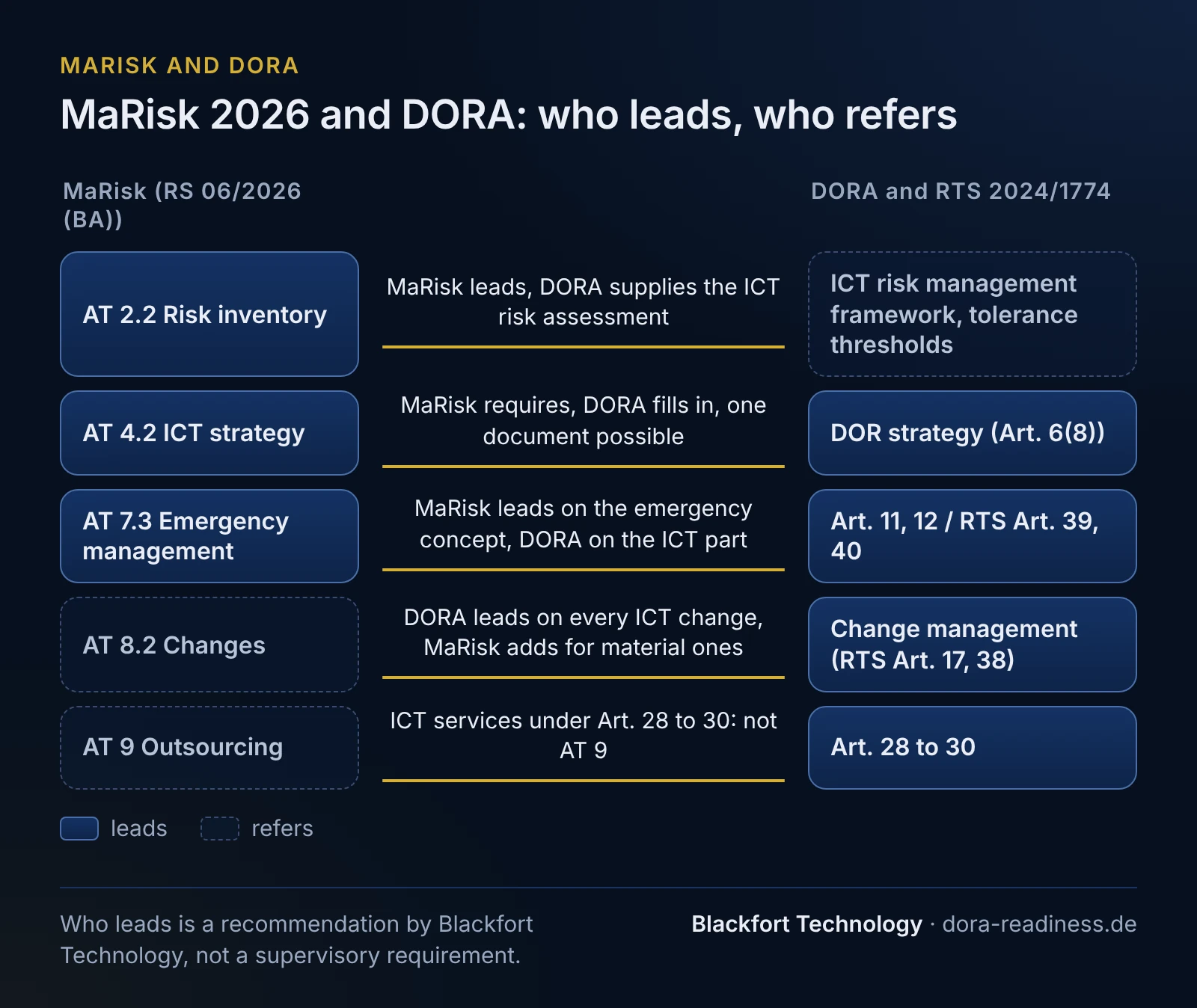
Interface matrix: who leads, who refers
Entirely fictitious example, not a client: Musterbank AG is a regional bank with 180 employees, a CRR credit institution without direct ECB supervision. It applies the MaRisk in full, and DORA under the full framework since 17 January 2025. It obtains its core banking system as a service from a data centre, and an audit firm handles parts of internal audit. In November 2026 it decides which rule leads at each interface and which document serves the other rule. The last column shows what is different for this website’s model institution: Muster-Factoring GmbH with 23 employees and total assets of EUR 61 million, so not a microenterprise, which applies Article 16 from 1 January 2027.
Interface matrix MaRisk ↔ DORA (template, completed with fictitious data, as of 6 November 2026):
| MaRisk | DORA counterpart (full framework) | Who leads, who refers | Implementation at Musterbank AG | Muster-Factoring GmbH from 1 Jan 2027 |
|---|---|---|---|---|
| AT 2.2 risk inventory | ICT risk management framework (Article 6), risk tolerance threshold (Article 6(8)(b)) | MaRisk leads on materiality and overall risk profile, DORA supplies the ICT risk assessment | inventory takes over the ICT risk assessment as a subcategory of operational risk | ICT risk assessment under RTS Article 31, check inclusion in the inventory under AT 2.1 Tz. 2 |
| AT 4.2 ICT strategy | DOR strategy (Article 6(8)) | MaRisk requires the strategy, DORA determines the content | one document “ICT and DOR strategy”, management board resolution | no DOR strategy, IT strategy recommended by BaFin, not a certain obligation |
| AT 4.4.2 compliance function | ICT risk control function (Article 6(4)) | DORA requires the function, the MaRisk allow the combination | control function placed with compliance, own task description and reporting line | no control function, segregation and independence under RTS Article 28(4) |
| AT 7.2 resources | ICT systems, capacity (Article 7, RTS Article 9) | DORA leads on ICT requirements, AT 7.2 remains the general standard for resources and data quality | capacity planning under the RTS, data quality in risk reporting | RTS Article 34 (capacity), AT 7 applies |
| AT 7.3 emergency management | Articles 11 and 12 | MaRisk leads on the emergency concept, DORA on the ICT part, shared list of functions and BIA | ICT business continuity policy as part of the emergency concept, quarterly report with ICT test results | AT 7.3 applies, ICT part under RTS Articles 39 and 40 |
| AT 8.2 changes | change management (RTS Article 17) | DORA leads on every ICT change, MaRisk adds the control analysis for material changes | mandatory question “material under AT 8.2?” in the change request | RTS Article 38 for all changes, check AT 8.2 under AT 2.1 Tz. 2 |
| AT 9 for ICT services | Articles 28 to 30 | DORA leads, AT 9 steps back | data centre with core banking system in the register of information, contract under Article 30(3) | Articles 28 to 30 from 1 January 2027, until then on our reading AT 9 and BAIT chapter 9 |
| AT 9 for other outsourcing | none | AT 9 alone leads | audit firm as material outsourcing under AT 9 | AT 9 applies |
| AT 9 Tz. 12 outsourcing management | role under Article 5(3), register of information (Article 28(3)) | both registers from one provider inventory, each entry flagged AT 9, DORA or both | outsourcing officer takes on the role under Article 5(3) | no role under Article 5(3) required, register of information applies |
The column “Who leads, who refers” is our recommendation for consistent documentation and not a supervisory requirement. Where Musterbank follows two rulebooks in one document, the document cites both references.
Three typical gaps
| Gap | Cause | Effect | Remedy |
|---|---|---|---|
| Outsourcing register and register of information not reconciled | Central outsourcing management maintains its register under AT 9, a DORA project builds the register of information separately. | Providers appear twice with different details, or in neither list. Audits reveal contradictory versions. | One provider inventory as the source for both registers, flagged AT 9, DORA or both, with a fixed reconciliation every quarter. |
| ICT risk only a lump-sum item in the risk inventory | The inventory lists “IT risks” as one line of operational risk, the ICT risk assessment from the DORA framework does not feed in. | Risk appetite and ICT tolerance thresholds do not match, and the risk strategy says nothing verifiable about ICT. | Take the results of the ICT risk assessment into the inventory every year, derive tolerance thresholds from the risk appetite and have both documents refer to each other. |
| Quarterly emergency management report without ICT tests | The report under AT 7.3 comes from the organisation department, the IT recovery tests run separately. | The management board does not learn of deficiencies from ICT tests in the way DORA and the RTS require, and the report shows a better state than the tests. | Include test results, open deficiencies and deadlines from the ICT tests as a fixed part of the quarterly report. |
Example, matrix and gaps are our professional assessment based on the wording of the MaRisk, DORA, the RTS and BaFin’s supervisory notices.
How we can help
Credit institutions under the full framework start with the DORA gap analysis: it shows where MaRisk documents and DORA evidence diverge and ends with an action plan. Institutions of the KWG group moving from BAIT on 1 January 2027 find the integration with the MaRisk in our service for the transition from BAIT to Article 16.
Frequently asked questions
What does the 9th MaRisk amendment mean for DORA implementation?+
Does AT 9 still apply to IT outsourcing?+
Does the ICT business continuity plan under RTS Article 39 replace the emergency concept under AT 7.3?+
Does AT 7.2 still apply alongside the ICT requirements of DORA?+
Read more
- BAIT and DORA: repeal, transition and the mapping as Excel
- ICT risk management under DORA: framework and DOR strategy
- Classifying critical or important functions under DORA
- DORA Article 16: the simplified ICT risk management framework
- DORA for factoring and leasing: obligations and evidence from 2027
- VAIT and DORA for insurers: mapping, MaGo and transition plan
- DORA gap analysis: quick check, Article 16 and full framework
Sources
- BaFin: Circular 06/2026 (BA) MaRisk of 30 June 2026, AT 2.1, 2.2, 4.2, 4.4.2, 7.2, 7.3, 8.2, 9 (PDF), in German (retrieved 2026-11-06)
- BaFin: news of 30 June 2026 “MaRisk amendment: more proportionality”, in German (retrieved 2026-11-06)
- Regulation (EU) 2022/2554 (DORA), Article 3(21), Articles 5, 6, 11, 12, 16, 28 to 30, German version (retrieved 2026-11-06)
- Delegated Regulation (EU) 2024/1774 (RTS on ICT risk management), Articles 9, 17, 28, 31, 34, 38 to 40, German version (retrieved 2026-11-06)
- BaFin: supervisory notice of 21 August 2025 on the simplified ICT risk management framework, sections 2.1, 5 and 7.2, in German (retrieved 2026-11-06)
- BaFin: supervisory notice of 8 July 2024 (as of June 2024) on implementing DORA, section 6.6, in German (retrieved 2026-11-06)
- BaFin DORA FAQ on whether DORA implementation is a material change under AT 8.2 MaRisk, in German (retrieved 2026-11-06)
- BaFin DORA FAQ on intra-group ICT service providers, in German (retrieved 2026-11-06)
- BaFin: DORA FAQs (third-party risk, regulated financial services), in German (retrieved 2026-11-06)
- German Banking Act (KWG), Section 1a(2a) and Section 65a(3) (unofficial version, in German) (retrieved 2026-11-06)
This content provides general technical and organisational information and does not constitute legal advice (no legal services within the meaning of the German RDG).