

Last updated: 2026-11-06
This page applies to both frameworks: to financial entities under the full framework of Articles 5 to 15 DORA and under the simplified framework of Article 16, including factoring and leasing firms, guarantee banks and the other institutions under Section 1a(2a) of the German Banking Act (KWG) (here: the KWG group) that move to DORA on 1 January 2027. Which framework applies to you is covered on the page on DORA applicability. This page deals with the question many obligations depend on: which of your functions are critical or important, and how you justify that.
What is a critical or important function?
Article 3(22) DORA describes a function with two alternatives. If one of them is met, the function is critical or important:
| Alternative | Question | Typical functions |
|---|---|---|
| 1. Business | Would its disruption materially impair the financial performance of the financial entity, or the soundness or continuity of its services and activities? | core business, payments, account and portfolio administration |
| 2. Regulatory | Would its discontinued, defective or failed performance materially impair the continuing compliance of the financial entity with the conditions and obligations of its authorisation, or with its other obligations under applicable financial services law? | regulatory reporting, risk control, functions the licence depends on |
Three points follow directly from the wording and are often overlooked:
- Yes or no: The regulation defines “critical or important function” as a single term without levels, and the same obligations attach to it. A scale such as “high, medium, low” from a protection needs assessment or a BIA therefore does not replace the classification (our own reading of the wording). You can keep internal gradings in addition, for example for recovery objectives.
- Function, not system: What is classified is an activity or a process. The ICT services, applications and providers that support it are then mapped to the function.
- More than availability: According to BaFin, the definition resembles the protection goal of availability but is not identical to it. A function can also be critical or important because of confidentiality. The second alternative also covers functions whose disruption could be absorbed for days, such as regulatory reporting.
Who classifies, and is there a BaFin list?
The financial entity classifies its functions itself (Article 28(4)(a) DORA). In its supervisory notice of 21 August 2025 (section 7.1), BaFin states that the assessment is based on the impact a disruption or reduced performance would have, and that this requires developing suitable criteria and assessing all the circumstances. We have not found a list of typical critical or important functions in BaFin’s FAQ and supervisory notices (as of 6 November 2026, some FAQ pages on the topic cannot currently be retrieved). Any list, including the example list further down, is therefore your own determination, and you have to justify it.
The classification must be in place no later than before a contract for ICT services is concluded: at that point the financial entity assesses whether the contract supports a critical or important function (Article 28(4)(a) DORA). Under the full framework (except microenterprises), the policy on ICT services sets the method and timing of this assessment (Commission Delegated Regulation (EU) 2024/1773, Article 3(2)). Under the Article 16 framework the policy is not mandatory, because Article 28(2) DORA does not apply there. We still recommend a written method, so that it remains traceable why a function is on the list or missing from it.
This is not to be confused with the critical ICT third-party service provider under Article 3(23) and Article 31 DORA, which the supervisory authorities designate (see FAQ below).
Is this the same as a material outsourcing?
No. According to BaFin, the assessment as “critical or important” is not identical in method or content to determining materiality for outsourcing (supervisory notice of 21 August 2025, section 7.1). Both assessments run side by side.
| Critical or important function (DORA) | Material outsourcing (MaRisk AT 9) | |
|---|---|---|
| Subject | the function within the firm, regardless of who performs it | the procurement of a service from a third party |
| Scope | all ICT services under Article 3(21), including other external procurement, software procurement and intra-group services | outsourcing. According to the explanatory note on AT 9 para. 1, ICT services subject to Articles 28 to 30 DORA are no longer covered |
| Result | yes or no per function | material or not material per outsourcing |
| Consequences | register, contract content under Article 30(3), exit strategy, concentration risk, incident classification, business continuity | requirements under AT 9 for non-ICT outsourcing |
A special rule applies to microenterprises in the KWG group: under Section 1a(2a) sentence 2 no. 3 KWG, Articles 28 to 30 DORA do not apply to them. In our reading, their external ICT procurement therefore stays within the scope of AT 9, insofar as MaRisk (BaFin’s Minimum Requirements for Risk Management) applies to them. When an institution counts as a microenterprise is explained on the page on DORA applicability.
How do you go about the classification?
The following approach is a recommendation by Blackfort Technology, not a supervisory requirement. It turns BaFin’s guidance into fixed steps and makes every decision verifiable.
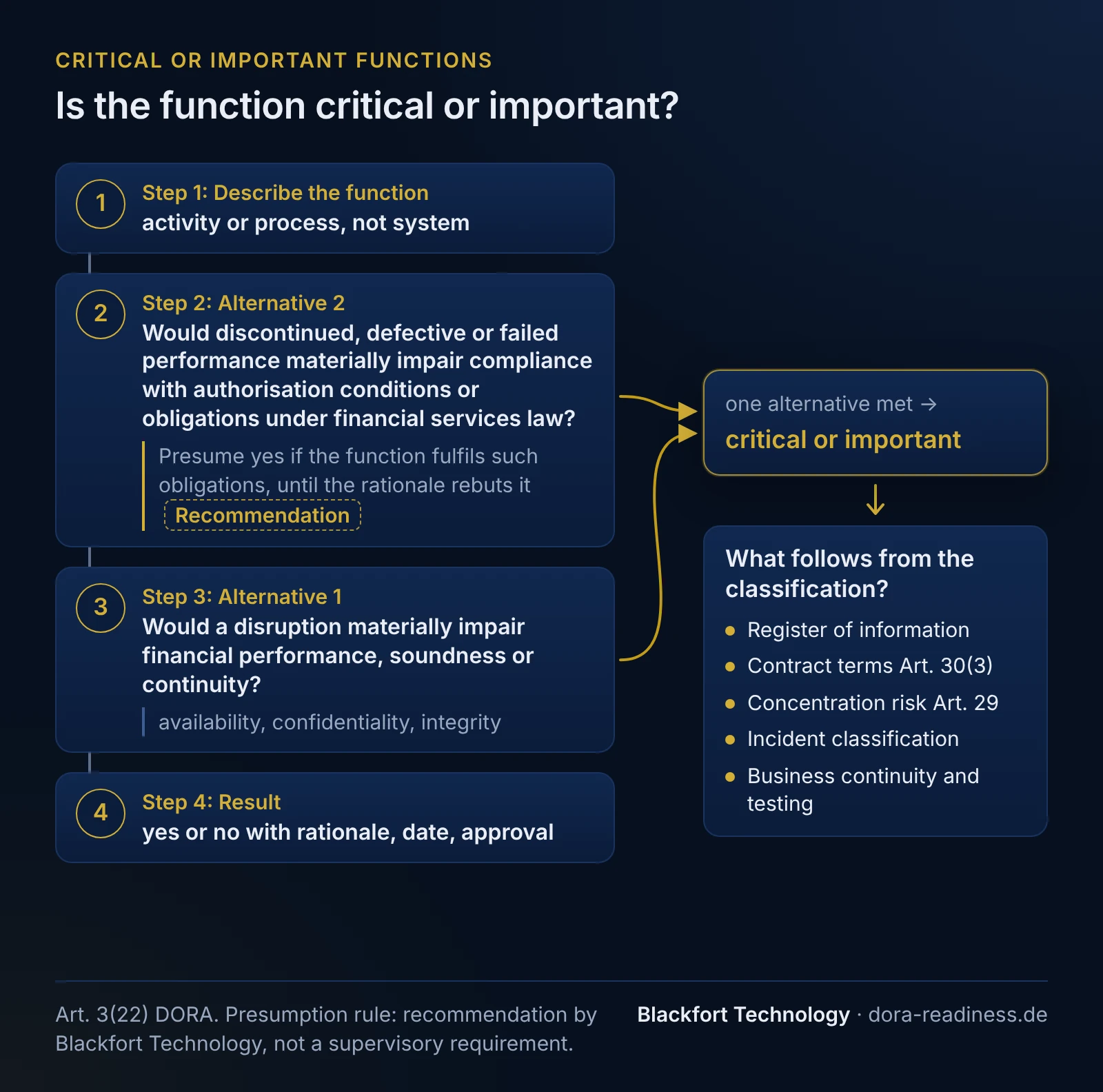
- Collect functions: from the process map or the business model, not from the application inventory. A function is an activity with its own result, such as “purchasing receivables”.
- Check alternative 2 with a presumption: treat functions through which the firm meets licensing conditions or obligations under financial services law as critical or important at first. The presumption is rebutted only with written reasons. In our reading of the wording, obligations outside financial services law, for example under employment law, do not belong in this alternative.
- Check alternative 1: assess the consequences of a disruption and of defective performance for earnings, liquidity, customers and continuity, including for confidentiality and integrity. The basis is the business impact analysis (Article 11(5) DORA under the full framework, RTS Article 28(2)(d) under the Article 16 framework).
- Record the result: for each function yes or no, which alternative applies, reasons in two or three sentences, date and approval. Under the Article 16 framework, the management body approves the classification under RTS Article 30(1) (RTS Article 28(2)(d)).
- Map the ICT: map to each critical or important function the supporting information and ICT assets, their dependencies and the ICT third-party service providers (Article 8(1) and (5) DORA under the full framework, RTS Article 30(1) and (2) under the Article 16 framework).
- Review: under the full framework the classification must be reviewed for adequacy at least once a year (Article 8(1)), under the Article 16 framework as needed (RTS Article 30(1)). Triggers are new products, new providers, major ICT changes and incidents. If a function becomes critical or important, the authority must be informed in a timely manner under Article 28(3), fifth subparagraph, DORA.
What follows from the classification?
The attribute runs through the whole regulation. The overview shows the main consequences per framework. The consequences from Articles 28 to 30 apply equally under the Article 16 framework, except for microenterprises in the KWG group:
| Consequence | Full framework | Article 16 framework |
|---|---|---|
| Register of information: flag contracts for critical or important functions separately, and record subcontractors for these services | Article 28(3), second subparagraph, Implementing Regulation (EU) 2024/2956 | same |
| Inform the authority in a timely manner about planned contracts and functions that have become critical or important | Article 28(3), fifth subparagraph | same |
| Before concluding a contract: consider the highest quality information security standards, decide on subcontracting | Article 28(5), Delegated Regulation (EU) 2025/532, Article 3 | same |
| Exit strategy, test exit plans | Article 28(8) | same |
| Assess concentration risk in advance, and legal risks for providers in third countries | Article 29 | same |
| Additional contract content: service levels, the provider’s contingency plans, audit and access rights, exit strategy with transition period | Article 30(3) | same. Participation in TLPT has no effect there, because TLPT does not apply |
| Incident classification: criterion “criticality of services affected” and threshold “downtime longer than two hours” | Delegated Regulation (EU) 2024/1772, Article 6(a), Article 9(3)(b) | same, for the KWG group since 17 January 2025 |
| Business continuity and recovery | Article 11, recovery time and recovery point per function, taking the classification into account (Article 12(6)) | Article 16(1)(f), plans with recovery levels and timeframes (RTS Article 39), tests at least annually (RTS Article 40) |
| Testing and remediation of test findings | annual tests of all ICT systems of these functions, except microenterprises, Article 24(6) | fix findings on these systems without undue delay (RTS Article 36(3)). Whether Article 24(6) also applies is open, we recommend planning the annual tests as a precaution (reasoning on the page on DORA Article 16) |
| Access and monitoring | RTS Title II | strong authentication for assets of these functions (RTS Article 33), continuous monitoring of threats and vulnerabilities (RTS Article 31(3)) |
For institutions that apply MaRisk, including on a partial basis such as factoring and leasing firms, AT 7.3 adds a requirement: an emergency concept must be maintained for critical or important functions and reviewed annually. The consequences under DORA attach to the ICT services that support a function. A list that is too generous therefore brings the additional content under Article 30(3) into every related contract.
For the KWG group, Articles 28 to 30 apply from 1 January 2027, but incident reporting under Chapter III has applied since 17 January 2025. Anyone who has to classify an ICT-related incident today therefore needs the function list now. How the classification works is set out on the page on DORA incident reporting.
Example: function list of a factoring firm
Fictitious example, not a client. Muster-Factoring GmbH buys receivables from mid-sized client companies. It has 23 staff and total assets of EUR 61 million, so it is not a microenterprise (for the test, see DORA applicability). As a financial services institution in the KWG group, it applies the simplified framework under Article 16 and Articles 28 to 30 DORA from 1 January 2027. It obtains its factoring core system as software as a service and processes payments through banking software. In October 2026 the management approves this function list:
| Function | Alternative 1: business | Alternative 2: regulatory | Result and reasons | Supporting ICT |
|---|---|---|---|---|
| Purchase of receivables with purchase and limit checks | yes: without purchases no new business, client companies wait for liquidity | yes (presumption): the licensed financial service itself, not rebutted | critical or important. Both alternatives met. | factoring core system (SaaS), interface to the credit agency |
| Payouts to client companies and payments | yes: a disruption is felt within hours by clients and in liquidity planning | not required | critical or important. Alternative 1 met. | banking software, bank connection via EBICS |
| Debtor accounting and payment allocation | yes: without allocation, receivables portfolio and purchase limits are wrong | not required | critical or important. Alternative 1 met, mainly because of defective performance. | factoring core system (SaaS) |
| Regulatory reporting | no: a disruption of several days without consequences for the business | yes (presumption): reporting obligations with fixed dates, not rebutted | critical or important. Alternative 2 met, although the tolerable downtime is long. | reporting software at the data centre provider |
| Document archive with client and debtor data | yes: disclosure of the debtor data would materially impair client relationships and continuity, a disruption would be tolerable for a few days | not required | critical or important. Because of confidentiality, not availability. | document management in the cloud |
| Dunning and debt collection | no: a backlog of two weeks can be caught up, the default risk barely rises | no: no licensing condition of its own affected | not critical or important. Review if dunning volume rises significantly. | module in the factoring core system |
| Payroll | no: a disruption can be bridged over one payroll run | no: obligations under employment and tax law, not financial services law | not critical or important. | payroll bureau with its own software |
| Website | no: new clients come through sales and intermediaries | no | not critical or important. | web hosting |
What the list triggers in the example: the contracts with the core system provider, the banking software provider, the credit agency (its interface supports the purchase of receivables), the data centre provider and the cloud archive are kept in the register of information as “supports a critical or important function” and are checked against the content of Article 30(3) from 2027. For the core system, which carries two of the five critical or important functions, the institution assesses concentration risk under Article 29 and sets an exit strategy. Web hosting and the payroll bureau stay in the register if they provide ICT services, but without the flag. And already today, an incident in the core system counts as affecting the criterion “criticality of services affected” in incident classification.
Three typical gaps
| Gap | Cause | Effect | Remedy |
|---|---|---|---|
| Classification by downtime only | The list is taken from the BIA or an availability scale. | Regulatory reporting, risk control and functions with confidential data are missing, including in incident classification. | Check both alternatives separately, assess confidentiality and integrity explicitly. |
| Treated as equal to material outsourcing | The existing AT 9 list is renamed. | Other external procurement, software and intra-group services are missing from the register and from contract review. | Rebuild the function list from the process map, continue the outsourcing assessment alongside it. |
| List without reasons and without upkeep | Created once in a project, result only as a tick. | Register, emergency concept and incident process use different versions. New providers are engaged without a classification. | One list as the single source, reasons per function, review with every new ICT contract, approval by the management. |
What Article 16 otherwise requires and where the function list appears in the other evidence is set out on the page on DORA Article 16. The register of information is explained on the page on the DORA register of information, managing ICT providers on the page on managing ICT third-party service providers.
How we support you
For institutions moving from BAIT (BaFin’s supervisory requirements for IT in banks) on 1 January 2027, the function list with business impact analysis and recovery objectives is part of the service for the transition from BAIT to Article 16. Everyone else, including entities under the full framework, starts with the DORA gap analysis. It shows where the existing classification has gaps.
Frequently asked questions
Does BaFin provide a list of critical or important functions?+
Does the classification also apply under the simplified framework of Article 16?+
Does a microenterprise in the KWG group have to classify functions?+
Is a function critical because the supervisors designated its provider as critical?+
Read more
- DORA Article 16: the simplified ICT risk management framework
- DORA for factoring and leasing: obligations and evidence from 2027
- DORA incident reporting: classifying and reporting ICT-related incidents
- DORA scope: who does DORA apply to, and which framework?
- DORA gap analysis: quick check, Article 16 and full framework
Sources
- Regulation (EU) 2022/2554 (DORA), Article 3(22) and (23), Articles 8, 11, 12, 16, 24, 28 to 30 (retrieved 2026-11-06)
- Delegated Regulation (EU) 2024/1774 (RTS on ICT risk management), Articles 28, 30, 31, 33, 36, 39, 40 (retrieved 2026-11-06)
- Delegated Regulation (EU) 2024/1773 (policy on ICT services), Article 3 (retrieved 2026-11-06)
- Delegated Regulation (EU) 2024/1772 (classification of incidents), Articles 6 and 9 (retrieved 2026-11-06)
- Implementing Regulation (EU) 2024/2956 (register of information) (retrieved 2026-11-06)
- Delegated Regulation (EU) 2025/532 (subcontracting), Article 3 (retrieved 2026-11-06)
- BaFin: supervisory notice of 21 August 2025 on the simplified ICT risk management framework (Article 16 DORA), sections 7.1 and 7.2, in German (retrieved 2026-11-06)
- BaFin: DORA FAQ (ICT third-party risk management, oversight framework), in German (retrieved 2026-11-06)
- BaFin: Circular 06/2026 (BA) MaRisk of 30 June 2026, AT 2.1, AT 7.3 and AT 9, in German (retrieved 2026-11-06)
- German Banking Act (KWG), Section 1a(2a) and Section 65a(3) (unofficial version, in German) (retrieved 2026-11-06)
This content provides general technical and organisational information and does not constitute legal advice (no legal services within the meaning of the German RDG).