

Last updated: 2026-11-06
DORA stands for Digital Operational Resilience Act. The regulation sets out how financial entities manage ICT risk, report incidents, test their resilience and manage their ICT service providers. Whether DORA applies to your firm, and under which framework, is covered on DORA applicability.
What does the DORA regulation cover?
The DORA regulation lays down uniform requirements for the security of the network and information systems that support the business processes of financial entities (Article 1(1)). For financial entities these are six topics: ICT risk management, reporting of major ICT-related incidents and voluntary notification of significant cyber threats, reporting of payment-related incidents (credit, payment and e-money institutions and account information service providers only), digital operational resilience testing, sharing of cyber threat information and the management of ICT third-party risk. In addition, the regulation sets rules on contracts with ICT third-party service providers, the oversight framework for critical ICT third-party service providers and the rules on supervision.
As a regulation, DORA applies directly and needs no German transposition act (Article 64). BaFin states that it will not issue circulars specifying DORA, because national supervisors have no rule-making power of their own for a European regulation. Detail comes from European legal acts and guidelines. In relation to the NIS2 Directive, DORA is the sector-specific act for financial entities identified as essential or important entities under NIS2 (Article 1(2)) and takes precedence for risk management and incident reporting. For NIS2 itself see NIS2-Readiness (in German).
When does DORA apply?
DORA has applied since 17 January 2025, and BaFin has said there will be no further transition period. Some institutions brought in by German law follow their own dates.
| Date | Event | Reference |
|---|---|---|
| 14 Dec 2022 | regulation adopted | title of the regulation |
| 27 Dec 2022 | published in Official Journal L 333, p. 1 | OJ L 333 of 27.12.2022 |
| 16 Jan 2023 | entry into force (twentieth day after publication) | Article 64, BaFin FAQ |
| 17 Jan 2025 | applicable, directly in every Member State | Article 64 |
| 16 Jan 2025 | German IT circulars KAIT, VAIT and ZAIT repealed at the end of the day | BaFin notice of 9 January 2025 |
| 17 Jan 2025 | incident reporting under Chapter III also for institutions under section 1a(2a) of the German Banking Act (KWG) | section 65a(3) sentence 2 KWG |
| 31 Dec 2026 | German IT circular BAIT fully repealed at the end of the day | BaFin notice of 9 January 2025 |
| 1 Jan 2027 | remaining DORA framework for institutions under section 1a(2a) KWG, with Article 16 instead of Articles 5 to 15 | section 1a(2a) with section 65a(3) sentence 1 KWG |
On 6 November 2026 the Official Journal database (Cellar) listed no amending act for DORA. That is the result of our own query, so check the current position before relying on it.
How is the regulation structured?
The regulation has nine chapters. Chapters II to V contain the obligations of financial entities, the others set out principles, supervision and final provisions.
| Chapter | Articles | Subject | Addressed to |
|---|---|---|---|
| I | 1-4 | General provisions: subject matter, scope, definitions, proportionality | all |
| II | 5-16 | ICT risk management: Articles 5-15 full framework, Article 16 simplified framework | financial entities |
| III | 17-23 | ICT-related incident management, classification and reporting | financial entities |
| IV | 24-27 | Digital operational resilience testing, Articles 26 and 27 threat-led penetration testing (TLPT) | financial entities, TLPT only where the authority requires it |
| V | 28-44 | Section I (Articles 28-30): managing ICT third-party risk. Section II (Articles 31-44): oversight of critical ICT third-party service providers | Section I financial entities, Section II supervisors and critical providers |
| VI | 45 | Information-sharing arrangements on cyber threats | financial entities, voluntary |
| VII | 46-56 | Competent authorities, cooperation, penalties, professional secrecy, data protection | authorities and Member States |
| VIII | 57 | Delegated acts | Commission |
| IX | 58-64 | Review clause, amendments to other regulations, entry into force | all |
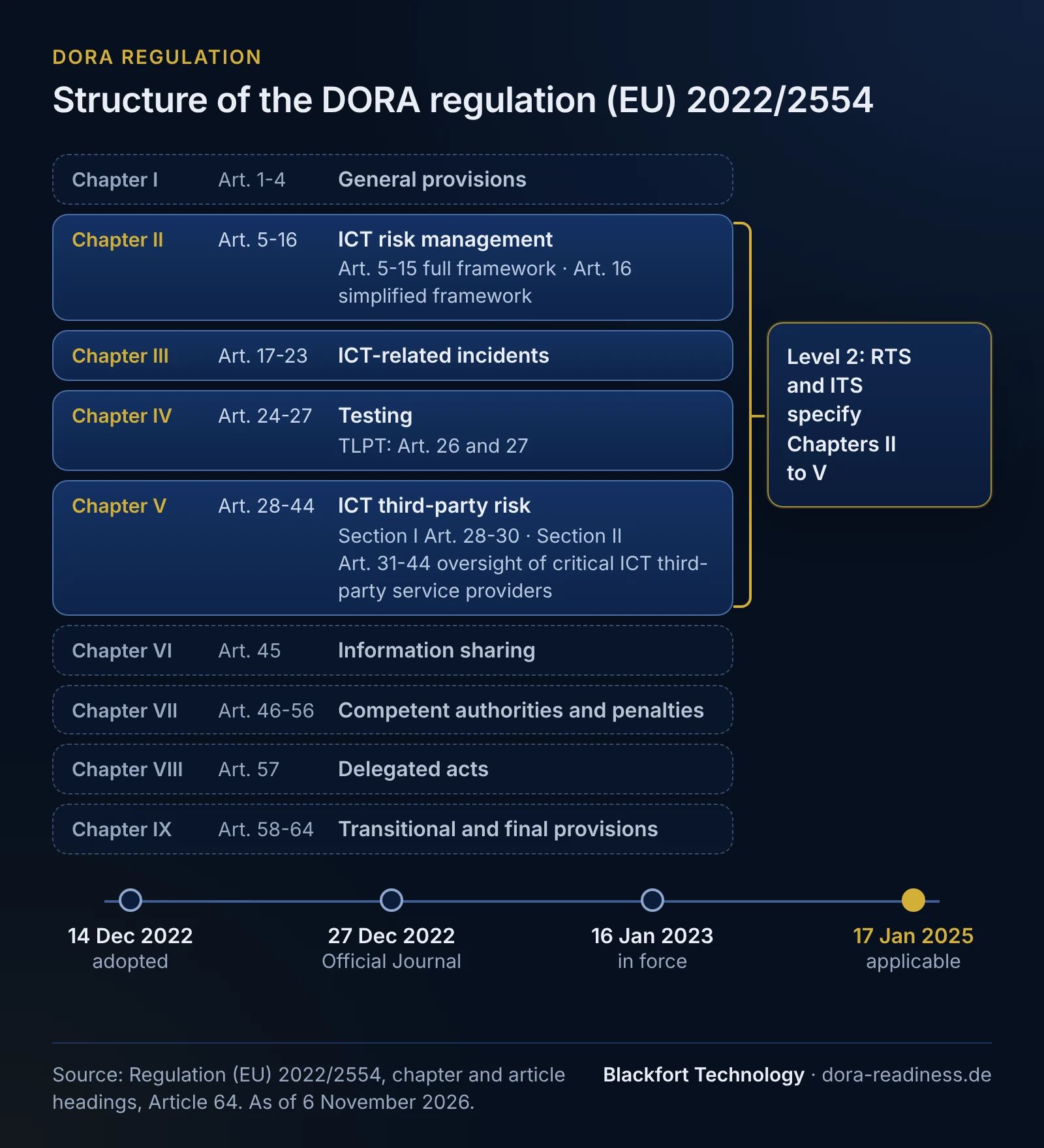
Article 4 sets the proportionality principle: it applies to Chapter II in general, and to Chapters III, IV and Section I of Chapter V only where the individual provisions say so. A firm under Article 16 replaces Articles 5 to 15 only. Chapters III to VI still apply in principle, with the exceptions explained on DORA Article 16.
Reading map: which article answers which question?
The reading map links the questions that usually come first to the article in the regulation and the matching level 2 act. It does not replace reading the text, it shows where to find it. The order is our suggestion for a first pass.
| Question | DORA | Level 2 | Explained on |
|---|---|---|---|
| Is our firm in scope? | Article 2(1) to (4), Article 3 (definitions) | - | Applicability |
| Full or simplified framework? | Article 16(1), Article 3(34) and (53) | RTS 2024/1774 Title III | Applicability, Article 16 |
| Is there relief for small firms? | Article 4, Article 3(60) (microenterprise) | RTS 2024/1774 Article 1 | - |
| What must the management body do? | Article 5 (full framework), Article 16(1)(a) | RTS 2024/1774 Article 28 (Article 16) | Article 16 |
| What belongs in the ICT risk management framework? | Articles 6 to 15 or Article 16 | RTS 2024/1774 Title II or III | Article 16 |
| Which functions are critical or important? | Article 3(22), Article 8 | RTS 2024/1774 Article 30 (Article 16) | - |
| How do we back up and restore? | Articles 11, 12 or Article 16(1)(f) | RTS 2024/1774 Articles 24 to 26 or 39, 40 | Article 16 |
| When and how do we report an incident? | Articles 17 to 19 | RTS 2024/1772, RTS 2025/301, ITS 2025/302 | - |
| Which tests are mandatory? | Articles 24 to 27 | RTS 2025/1190 (TLPT) | Article 16 (our reading for Article 16 firms) |
| What goes into contracts with ICT providers? | Articles 28 to 30 | RTS 2024/1773, RTS 2025/532 | - |
| What is in the register of information? | Article 28(3) | ITS 2024/2956 | - |
| What applies to our IT provider itself? | Article 2(1)(u), Article 3(19) and (23), Article 31 | - | DORA for ICT providers |
| May we share threat information? | Article 45 | - | this section |
| Who supervises us, and what are the penalties? | Article 46, Articles 50 to 54 | - | Supervision in Germany |
On Article 45: financial entities may share information on cyber threats with each other, such as indicators of compromise and alerts, where this serves resilience. They notify the competent authority when they join such an arrangement and when they leave it (Article 45(3)).
Level 2: which RTS and ITS specify DORA?
The Commission adopts regulatory technical standards (RTS) as delegated regulations and implementing technical standards (ITS) as implementing regulations. Both apply directly, like DORA, and mainly specify Chapters II to V. For most financial entities these eight acts matter:
| Act | dated | Subject | legal basis in DORA |
|---|---|---|---|
| Delegated Regulation (EU) 2024/1774 | 13 Mar 2024 | ICT risk management: Title II full framework (Articles 2-27), Title III simplified framework (Articles 28-41) | Article 15, Article 16(3) |
| Delegated Regulation (EU) 2024/1772 | 13 Mar 2024 | classification of incidents and cyber threats | Article 18(4) |
| Delegated Regulation (EU) 2025/301 | 23 Oct 2024 | content and time limits for initial, intermediate and final reports | Article 20(3) |
| Implementing Regulation (EU) 2025/302 | 23 Oct 2024 | reporting templates and procedures | Article 20(4) |
| Implementing Regulation (EU) 2024/2956 | 29 Nov 2024 | standard templates for the register of information | Article 28(9) |
| Delegated Regulation (EU) 2024/1773 | 13 Mar 2024 | policy on contracts for ICT services supporting critical or important functions | Article 28(10) |
| Delegated Regulation (EU) 2025/532 | 24 Mar 2025 | subcontracting of ICT services supporting critical or important functions | Article 30(5) |
| Delegated Regulation (EU) 2025/1190 | 13 Feb 2025 | threat-led penetration testing (TLPT) in line with TIBER-EU | Article 26(11) |
Further acts deal with the oversight framework for critical ICT third-party service providers and are aimed mainly at supervisors and providers, so they are not listed here. Guidelines of the European Supervisory Authorities come on top. Firms under Article 16 do not apply Delegated Regulation 2024/1773, because Article 28(2) does not apply to them.
German add-ons: the FinmadiG
The German Financial Market Digitalisation Act (FinmadiG, Federal Law Gazette 2024 I No. 438 of 27 December 2024) extends DORA to institutions the regulation itself does not name, such as factoring and finance leasing firms and guarantee banks (section 1a(2a) with section 65a(3) KWG), to regional development banks (section 1a(2) KWG) and to insurance holding companies (section 293(5) of the Insurance Supervision Act, VAG). Who exactly is covered, and under which framework, is set out on DORA applicability.
Supervision in Germany: BaFin, ECB and Bundesbank
Which authority supervises DORA follows from Article 46 and sectoral law. For credit institutions, Article 46(a) points to the national banking supervisor and, for significant credit institutions, to the ECB. The German Banking Act implements this as follows: the competent authorities under Article 46 are the supervisory authorities under section 1(5) KWG, that is the ECB where it is competent within the Single Supervisory Mechanism and BaFin otherwise (section 6(1g) KWG). For TLPT, BaFin works with the Deutsche Bundesbank, which carries out the operational tasks. For other financial entities, Article 46 names the authority competent under the relevant sectoral law.
Reports go to BaFin: major incidents through its reporting and publishing platform (MVP), significant credit institutions also to the national authority, which forwards them to the ECB (Article 19(1)). The register of information is submitted once a year through the MVP. The European Supervisory Authorities designate and oversee critical ICT third-party service providers, and according to BaFin only the supervisors assess criticality.
Which BaFin sources matter?
| Source (German) | Date | Content | Status (our classification) |
|---|---|---|---|
| Supervisory notice on implementing DORA in ICT risk management and ICT third-party risk management | as of June 2024, published 8 July 2024 | maps Chapters 1 to 10 of BAIT and VAIT to the full framework and Articles 28 to 30, with an annex on minimum contract content | implementation guidance |
| Supervisory notice on implementing DORA with the simplified framework (Article 16 DORA) and ICT third-party risk management | 21 Aug 2025 | nine sections: scope plus eight comparisons with BAIT and VAIT | expressly not a binding interpretation |
| Notice “DORA kommt” on changes to the IT requirements | 9 Jan 2025 | repeal of KAIT, VAIT, ZAIT, staged repeal of BAIT | information on administrative practice |
| DORA FAQ (collection page and single questions) | ongoing, retrieved 6 Nov 2026 | scope, third parties, TLPT, oversight, incident reporting, register | interpretive aid, some earlier addresses no longer available |
| Page on the register of information and notifications | ongoing, retrieved 6 Nov 2026 | submission through the MVP, deadline 31 March, reference date 31 December | procedural guidance |
| Guidance on completing the incident report form | as of 15 May 2026 | fields of the initial, intermediate and final report | procedural guidance |
| MaRisk, Circular 06/2026 (BA) | 30 Jun 2026 | continues to apply alongside DORA | circular |
Our suggestion: keep the sources with date and retrieval date in a register of applicable rules. The supervisory notices help with restructuring, but the wording of DORA and the level 2 acts is what counts.
What are the penalties?
DORA gives competent authorities supervisory, investigatory and sanctioning powers (Article 50(1)). Member States lay down administrative penalties and remedial measures that are effective, proportionate and dissuasive (Article 50(3)). These include at least orders to cease conduct, measures including those of a pecuniary nature and public notices naming the person and the nature of the breach (Article 50(4)). Subject to national law, penalties can also be imposed on members of the management body (Article 50(5)). We do not describe the German fine provisions here.
Example: a small investment firm reads the regulation
Fictitious example. A wealth manager licensed as an investment firm, with twelve staff, has to record for its auditor which DORA provisions it applies. Using the reading map, management works through it like this:
- Article 2(1)(e): investment firms are financial entities, so DORA applies.
- Article 3(34) and Article 16(1): if the firm meets the conditions of Article 12(1) of Regulation (EU) 2019/2033, it is small and non-interconnected and applies Article 16. It records the result, with figures, in a classification record (Applicability).
- Delegated Regulation 2024/1774 Title III: Articles 28 to 41 are the checklist for its own framework (Article 16).
- Chapter III: incident management and reporting apply, Article 16 replaces nothing here. Only the rule on aggregating recurring incidents in Article 8(2) of Delegated Regulation 2024/1772 does not apply to the entities referred to in Article 16(1) DORA, including this investment firm. Whether it also covers factoring and leasing institutions brought in by section 1a(2a) KWG is an open question.
- Chapter IV: TLPT does not apply (Article 26(1)). Articles 24 and 25 contain no exception for Article 16 firms, the reasoning is on Article 16.
- Chapter V Section I: Articles 28 to 30 apply, without the strategy under Article 28(2).
- Article 46(c): the competent authority is the one designated for investment firms.
The result is a one-page list of applicable rules with a date that the auditor can follow. Whether the conditions of Article 12(1) of Regulation (EU) 2019/2033 are met depends on the individual case and belongs in the legal review.
Three typical gaps in working with the regulation
| Gap | Cause | Effect | Remedy |
|---|---|---|---|
| Only the regulation was read | RTS and ITS are published as separate acts and are missing from many internal lists of applicable rules. | Detailed duties such as the reporting deadlines in Delegated Regulation 2025/301 or the RTS Title III checklist are missing from policies and procedures. | Keep a register with DORA and all relevant level 2 acts and cite both references for each duty. |
| Sources without a date | References are copied once and never checked again. BaFin has restructured its FAQ pages, and some addresses no longer return a page. | Policies point to sources that cannot be retrieved or to repealed circulars, and the auditor finds no valid reference. | Record each source with version and retrieval date and check it at least once a year and whenever new acts appear (our suggestion). |
| Only one language version was read | Advisers and group documents work from the English text. | Differences go unnoticed, for example the IORP threshold in Article 2(3)(c) or “events” in English against “Vorfälle” (incidents) in German in Article 34(f) of RTS 2024/1774. | For thresholds and key terms, read both versions side by side, record differences and seek legal advice where in doubt. |
How we can help
We compare your documents with the parts of the regulation and the level 2 acts that may apply to you, based on what you tell us. The starting point is the DORA gap analysis. This is general information. The legal assessment of your case remains with your legal advisers.
Frequently asked questions
Is there a German DORA act?+
Does BaFin have to turn DORA into a circular first?+
Are BaFin supervisory notices binding?+
Has the DORA regulation been amended since 2022?+
Read more
- DORA requirements: obligations matrix for the full framework and Article 16
- DORA scope: who does DORA apply to, and which framework?
- DORA Article 16: the simplified ICT risk management framework
- DORA incident reporting: classifying and reporting ICT-related incidents
- BAIT and DORA: repeal, transition and the mapping as Excel
Sources
- Regulation (EU) 2022/2554 (DORA), Articles 1 to 4, 16, 19, 26, 45, 46, 50, 64 (retrieved 2026-11-06)
- Delegated Regulation (EU) 2024/1774 (ICT risk management), Titles II and III (retrieved 2026-11-06)
- Delegated Regulation (EU) 2024/1772 (classification of incidents) (retrieved 2026-11-06)
- Delegated Regulation (EU) 2025/301 (content and time limits of reports) (retrieved 2026-11-06)
- Implementing Regulation (EU) 2025/302 (reporting templates) (retrieved 2026-11-06)
- Implementing Regulation (EU) 2024/2956 (register of information) (retrieved 2026-11-06)
- Delegated Regulation (EU) 2024/1773 (contractual policy) (retrieved 2026-11-06)
- Delegated Regulation (EU) 2025/532 (subcontracting) (retrieved 2026-11-06)
- Delegated Regulation (EU) 2025/1190 (TLPT) (retrieved 2026-11-06)
- Financial Market Digitalisation Act (FinmadiG), Federal Law Gazette 2024 I No. 438 of 27 December 2024 (German) (retrieved 2026-11-06)
- German Banking Act, section 1(5) (unofficial version, German) (retrieved 2026-11-06)
- German Banking Act, section 1a(2) and (2a) (unofficial version, German) (retrieved 2026-11-06)
- German Banking Act, section 6(1g) (unofficial version, German) (retrieved 2026-11-06)
- German Banking Act, section 65a(3) (unofficial version, German) (retrieved 2026-11-06)
- Insurance Supervision Act, section 293(5) (unofficial version, German) (retrieved 2026-11-06)
- BaFin: IT and cyber security section (German) (retrieved 2026-11-06)
- BaFin: notice of 9 January 2025 on changes to the IT requirements (German) (retrieved 2026-11-06)
- BaFin: supervisory notice on implementing DORA in ICT risk and ICT third-party risk management, as of June 2024, published 8 July 2024 (German) (retrieved 2026-11-06)
- BaFin: supervisory notice on implementing DORA with the simplified framework (Article 16 DORA), 21 August 2025 (German) (retrieved 2026-11-06)
- BaFin: DORA FAQ, collection page (German) (retrieved 2026-11-06)
- BaFin: FAQ on circulars specifying DORA (German) (retrieved 2026-11-06)
- BaFin: register of information and notifications (German) (retrieved 2026-11-06)
- BaFin: guidance on completing the incident report form, as of 15 May 2026 (German) (retrieved 2026-11-06)
This content provides general technical and organisational information and does not constitute legal advice (no legal services within the meaning of the German RDG).