

Last updated: 2026-11-06
Classification answers two questions: does DORA (Regulation (EU) 2022/2554, applicable since 17 January 2025) apply to your organisation, and if so, under which framework? Where national rules extend the scope, this page follows German law.
Which entities does Article 2 DORA list?
Article 2(1) lists 21 types of entity. Points (a) to (t) are collectively called “financial entities” (Article 2(2)), and only they carry the obligations of the regulation.
| Point | Type of entity | Point | Type of entity |
|---|---|---|---|
| a | credit institutions | k | managers of alternative investment funds |
| b | payment institutions, including those exempted under PSD2 | l | management companies |
| c | account information service providers | m | data reporting service providers |
| d | electronic money institutions, including exempted ones | n | insurance and reinsurance undertakings |
| e | investment firms | o | insurance, reinsurance and ancillary insurance intermediaries |
| f | crypto-asset service providers authorised under MiCA, issuers of asset-referenced tokens | p | institutions for occupational retirement provision (IORPs) |
| g | central securities depositories | q | credit rating agencies |
| h | central counterparties | r | administrators of critical benchmarks |
| i | trading venues | s | crowdfunding service providers |
| j | trade repositories | t | securitisation repositories |
Point (u) covers ICT third-party service providers, which are not financial entities. “Credit institution” in point (a) means a CRR credit institution: according to BaFin, any firm taking deposits and granting loans has been directly in scope since 17 January 2025. German institutions without that combination, such as guarantee banks, come in through the national extension.
Which exemptions does Article 2(3) provide?
- (a) managers of alternative investment funds referred to in Article 3(2) AIFMD (small registered managers)
- (b) insurance and reinsurance undertakings referred to in Article 4 Solvency II, which are outside Solvency II because of their small size
- (c) IORPs whose pension schemes together have no more than 15 members (German article text: fewer than 15, see the note below)
- (d) persons exempted under Articles 2 and 3 MiFID II
- (e) insurance, reinsurance and ancillary insurance intermediaries that are micro, small or medium-sized enterprises
- (f) post office giro institutions referred to in the CRD
Note on point (c): the language versions differ. The English text reads “not more than 15 members”, and recital 39 of the German version also says “nicht mehr als 15” (not more than 15). Only the German article text reads “weniger als 15” (fewer than 15). Whether DORA applies to an IORP with exactly 15 members is therefore open. All language versions are equally authentic. Have this edge case reviewed by a lawyer.
According to BaFin, regulated firms outside DORA still have to manage ICT and cyber risks as part of proper business organisation.
Who is added by German law?
The German Financial Market Digitalisation Act (FinmadiG) extends the scope through the Banking Act (KWG), the KfW Regulation (KfWV) and the Insurance Supervision Act (VAG):
| Who | Provision | Framework | Since when |
|---|---|---|---|
| regional development banks | Section 1a(2) KWG | full framework, treated as CRR credit institutions | Section 65a(3) KWG sets no transition period for them |
| KfW | KfW Regulation (Section 1(1) sentence 1 no. 4, Section 2 no. 8, Section 3 nos. 16-18 KfWV), as assigned in the BaFin notice of 21 August 2025 | full framework | not stated separately in the notice |
| all other institutions under Section 1(1b) KWG not already covered by Article 2 (here: the KWG group). According to BaFin these include in particular guarantee banks, factoring and finance leasing firms, crypto securities registrars, housing companies with savings schemes, third-country branches under Section 53 KWG | Section 1a(2a) in conjunction with Section 65a(3) KWG | Article 16 instead of Articles 5-15, no TLPT, microenterprises exempt from Articles 28-30 | incident reporting (Chapter III) since 17 January 2025, everything else from 1 January 2027. Until 31 December 2026 the BAIT apply |
| insurance holding companies, holding undertakings under Section 293(4) VAG | Section 293(5) VAG | Article 16 | no transition period stated |
BaFin will repeal the BAIT, the German banking IT circular, in full with effect from the end of 2026. Financial holding companies are neither in scope today nor part of the KWG group, but the BAIT apply to them until the end of 2026. What applies to them from 2027 is open in the sources we reviewed.
Which framework applies?
Under DORA itself, only two groups fall under Article 16 in Germany: small and non-interconnected investment firms (Article 3(34)) and small IORPs (Article 3(53)). Germany did not use the exemptions in the Payment Services and E-Money Directives, so payment and e-money institutions apply the full framework, however small they are.
| Framework | under DORA | under German law |
|---|---|---|
| full framework (Articles 5-15) | all financial entities not exempted and not under Article 16, e.g. CRR credit institutions, payment and e-money institutions, fund management companies, Solvency II insurers, IORPs with 100 or more members, large insurance intermediaries | KfW (KfW Regulation), regional development banks (Section 1a(2) KWG) |
| simplified framework (Article 16) | small and non-interconnected investment firms, IORPs with 16-99 members (German text: 15-99) | KWG group under Section 1a(2a) KWG (from 2027), insurance holding companies |
| out of scope | exemptions under Article 2(3) | financial holding companies: BAIT until end of 2026, then open |
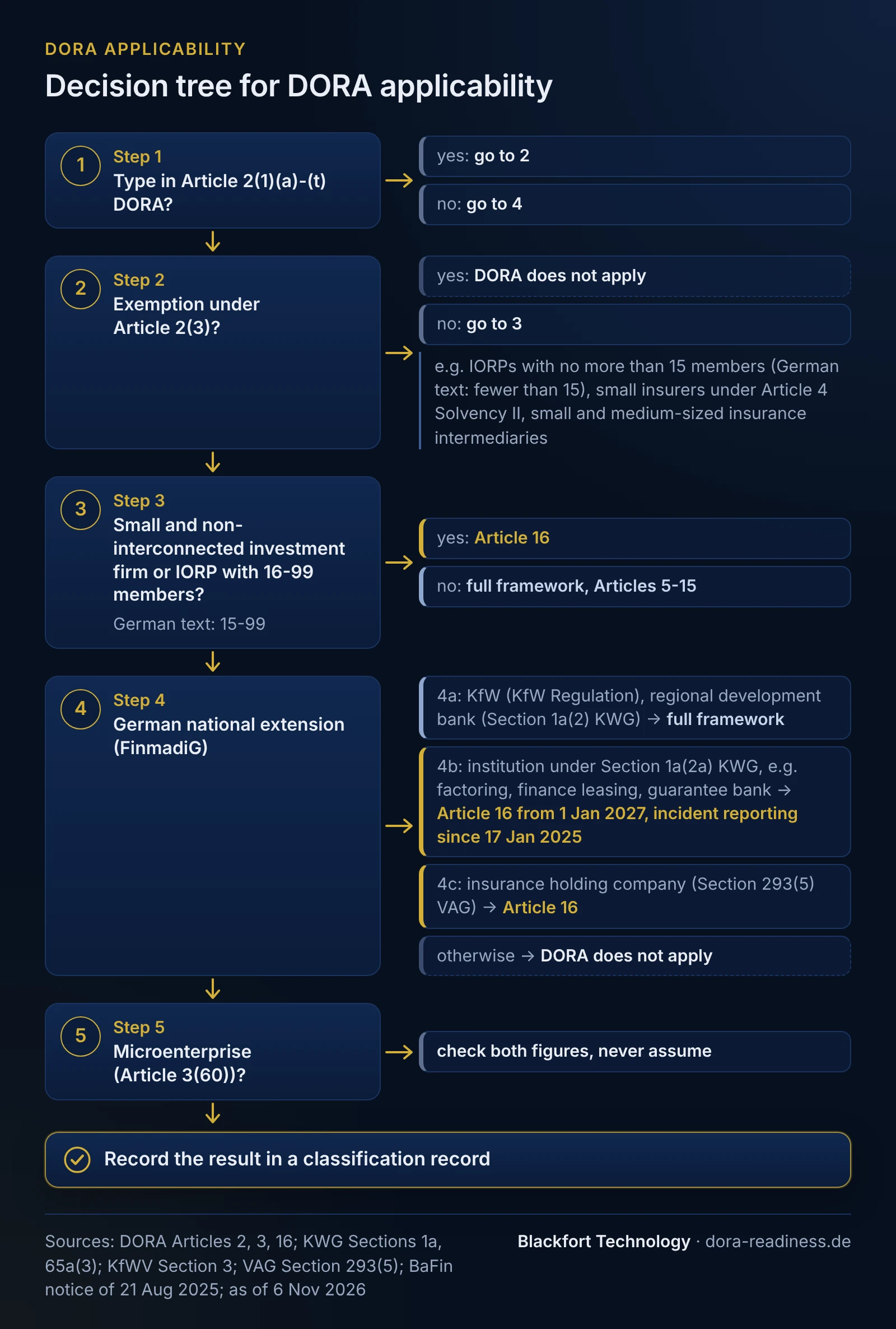
Work through the questions in order:
- Does the entity, by its licence, belong to a type in Article 2(1)(a) to (t)? If not, go to 4.
- Does an exemption under Article 2(3) apply? If yes: out of scope.
- Is it a small and non-interconnected investment firm or an IORP with 16-99 members (German text: 15-99, see the note on point (c))? If yes: Article 16, otherwise the full framework.
- Is it KfW or a regional development bank? Full framework. An institution under Section 1(1b) KWG? Article 16 from 2027, reporting since January 2025. An insurance holding company under Section 293 VAG? Article 16. Otherwise: out of scope.
- For every in-scope result: check microenterprise status with documented figures (next section).
Where a firm holds several licences, assign each licence to a type. If one of them falls under Article 2(1), the firm as a whole is directly in scope, as a payment institution under the full framework, including its factoring business. Section 1a(2a) KWG then does not apply by its wording, because sentence 1 only covers institutions not already in scope under Article 2 DORA. This is our reading of the wording. Have it confirmed for your case by a lawyer.
Microenterprises: why the status must never be assumed
Under Article 3(60), a microenterprise is a financial entity (other than a trading venue, central counterparty, trade repository or central securities depository) that employs fewer than 10 persons and “has an annual turnover and/or annual balance sheet total that does not exceed EUR 2 million”. The German text (“bzw.”) is equally unclear on whether one figure suffices. For the KWG group, Articles 28-30 and therefore the register of information do not apply to microenterprises. Record headcount, turnover and balance sheet total with reference date and source. If one financial figure exceeds EUR 2 million, we advise planning without the relief and seeking legal clarification. In our assessment, firms with a sizeable receivables or leasing portfolio usually exceed EUR 2 million in total assets.
Are ICT service providers in scope?
Not as financial entities. According to BaFin, DORA affects ICT third-party service providers indirectly through the contractual requirements their financial clients must include, and they have no incident reporting obligation under DORA. Their own reporting obligations, for example under NIS2 or German telecoms law, may still apply. The exception is critical ICT third-party service providers designated by the European Supervisory Authorities under Article 31, which fall under the oversight framework.
Does NIS2 apply as well?
Whether a financial entity is also an NIS2 entity is a separate assessment under Section 28 of the German BSI Act (see NIS2-Readiness: NIS2 applicability (in German)). If it is, Section 28(6) BSIG disapplies Sections 30-32, 35, 36, 38 and 39, while registration under Section 33 may remain. For the KWG group this follows from the wording from 1 January 2027 and is not established for the period before.
Self-check
These questions give a first indication only. The result is not an assessment and not legal advice.
- Which licences does the firm hold, and which Article 2(1) type does each correspond to?
- Does it take deposits and grant loans?
- Does one of the exemptions in Article 2(3)(a), (b), (d) or (f) apply?
- Is it an insurance intermediary, and if so, is it micro, small or medium-sized under Article 3(60), (63), (64)?
- Is it an IORP, and how many members do all its schemes have together?
- Is it an investment firm meeting the conditions of Article 12(1) of Regulation (EU) 2019/2033?
- Is it KfW, a regional development bank, an institution under Section 1(1b) KWG not covered by Article 2 (such as a factoring or leasing firm) or an insurance holding company under Section 293 VAG?
- What were headcount, turnover and balance sheet total at the last reference date?
Example: classification record of a factoring firm
Fictitious example, not a client. Muster-Factoring GmbH buys receivables from mid-sized companies. It has 23 employees, total assets of EUR 61 million and revenue of EUR 9.6 million, takes no deposits, provides no payment services and currently applies the BAIT.
| Check | Finding | Evidence | Provision |
|---|---|---|---|
| Licence | factoring as a financial service, no other licence | BaFin licence | Section 1(1a) sentence 2 no. 9 KWG |
| Article 2(1) DORA | none of the types (a) to (t) | licence, business model | Article 2(1), (2) DORA |
| National extension | institution under Section 1(1b) KWG not covered by Article 2 | - | Section 1a(2a) sentence 1 KWG |
| Framework | Article 16, no TLPT | - | Section 1a(2a) sentence 2 nos. 1, 2 KWG |
| Dates | incident reporting since 17 January 2025, everything else from 1 January 2027, BAIT until 31 December 2026 | reporting procedure, transition plan | Section 1a(2a) in conjunction with Section 65a(3) KWG |
| Microenterprise | no: 23 employees, total assets and revenue both above EUR 2 million (31 December 2025) | annual accounts 2025 | Article 3(60) DORA |
| Third parties | Articles 28-30, including the register of information, apply from 2027 | supplier list | Section 1a(2a) sentence 2 no. 3 KWG does not apply |
| Result | in scope, simplified framework under Article 16 from 1 January 2027 | - | - |
| Review | annually after the accounts are approved and after any new licence | compliance calendar | own rule |
| Prepared / approved | information security officer / management body, 15 September 2026 | signature | - |
Three typical gaps
| Gap | Cause | Effect | Remedy |
|---|---|---|---|
| Article 16 inferred from size | licence and legal basis not checked | a payment institution plans for the simplified framework although the full framework applies | classify by licence and legal basis, record the reasoning |
| Microenterprise status assumed | only headcount counted | Articles 28-30 and the register missing from the 2027 plan | record both financial figures, plan without the relief if in doubt |
| Incident reporting overlooked | “DORA only applies to us from 2027” | no procedure for major ICT-related incidents although required since January 2025 | set up and rehearse classification and reporting |
Gaps and remedies are our own assessment. Classification in an individual case remains a legal question. If Article 16 applies, our page on DORA Article 16 shows what it requires. Once the framework is clear, our DORA gap analysis shows where your firm stands.
Frequently asked questions
Does Article 16 apply to all small financial entities?+
How often should we repeat the classification?+
We have fewer than ten employees. Are we a microenterprise?+
What applies to financial holding companies from 2027?+
Read more
- DORA Article 16: the simplified ICT risk management framework
- DORA for factoring and leasing: obligations and evidence from 2027
- BAIT and DORA: repeal, transition and the mapping as Excel
- DORA incident reporting: classifying and reporting ICT-related incidents
- DORA gap analysis: quick check, Article 16 and full framework
Sources
- Regulation (EU) 2022/2554 (DORA), German version, recital 39, Articles 2, 3, 16 (retrieved 2026-11-06)
- Regulation (EU) 2022/2554 (DORA), English version, recital 39, Articles 2, 3, 16 (retrieved 2026-11-06)
- Directive 2009/138/EC (Solvency II), Article 4 (retrieved 2026-11-06)
- German Banking Act (KWG), Section 1 (definitions), in German (retrieved 2026-11-06)
- German Banking Act (KWG), Section 1a(2) and (2a), in German (retrieved 2026-11-06)
- German Banking Act (KWG), Section 65a(3) transitional provision, in German (retrieved 2026-11-06)
- KfW Regulation (KfWV), Section 3 nos. 16-18, in German (retrieved 2026-11-06)
- German Insurance Supervision Act (VAG), Section 293(4) and (5), in German (retrieved 2026-11-06)
- German BSI Act (BSIG), Section 28(6), in German (retrieved 2026-11-06)
- BaFin supervisory notice on DORA with the simplified ICT risk management framework (Article 16), 21 August 2025, section 1 and table 1, in German (retrieved 2026-11-06)
- BaFin DORA FAQ, question 13 (institutions under Section 1a(2a) KWG, financial holding companies), in German (retrieved 2026-11-06)
- BaFin: DORA FAQs (scope, oversight framework, reporting), in German (retrieved 2026-11-06)
- BaFin news of 9 January 2025 on changes to IT requirements under DORA, in German (retrieved 2026-11-06)
This content provides general technical and organisational information and does not constitute legal advice (no legal services within the meaning of the German RDG).