

Last updated: 2026-11-06
This page applies to both frameworks: to financial entities under the full framework and under the simplified framework of Article 16 DORA, which from 1 January 2027 also includes factoring and leasing firms and the other institutions under Section 1a(2a) of the German Banking Act (KWG) (“KWG group” below), unless they are microenterprises. Which framework applies to you is explained on DORA applicability.
Who has to maintain a register of information?
Every financial entity to which Article 28 DORA applies. The register belongs to Article 28(3) and is maintained at entity level and at sub-consolidated and consolidated levels. Under the simplified framework of Article 16, Articles 28 to 30 also apply in principle, with reliefs such as dropping the strategy under Article 28(2) that do not affect the register (BaFin supervisory notice of 21 August 2025, section 7.2). Microenterprises also keep a register under DORA. The Regulation provides no exemption.
Who does not have to: For microenterprises in the KWG group, Articles 28 to 30 DORA do not apply under Section 1a(2a) sentence 2 no. 3 KWG. On our reading, the register therefore also falls away for them, because it sits in Article 28(3). This special rule is in the KWG and does not apply to other DORA microenterprises. Whether your institution is a microenterprise you check with both figures, as described on DORA applicability. Do not assume the status. ICT providers themselves do not keep a register, DORA places obligations only on financial entities. What your financial customers need from you for their register is set out on DORA for ICT providers.
What goes into the register?
All contractual arrangements on the use of ICT services provided by ICT third-party service providers (Article 28(3), first subparagraph). ICT services are digital and data services provided through ICT systems on an ongoing basis, including hardware as a service, excluding traditional analogue telephone services (Article 3(21)). The term is wider than outsourcing. Annex III of the Implementing Regulation lists 19 types, from project management and development through software licensing and operation including maintenance to cloud services. According to BaFin, the register includes:
- the direct ICT third-party service provider (rank 1) in every case, regardless of whether the service supports a critical or important function,
- for services supporting critical or important functions, all subcontractors that effectively underpin the provision of the service,
- for intra-group ICT providers, at least the first subcontractor outside the group, even without a link to critical or important functions.
BaFin’s MVP does not go into the register, and the Deutsche Bundesbank is not an ICT third-party service provider under DORA either. Additional information for your own contract management is permitted (Article 5(2) of the Implementing Regulation). In groups, the parent undertaking decides which entities are included (Article 6(1)).
How is the register structured?
Implementing Regulation (EU) 2024/2956 prescribes 15 templates (Annex I). Each template is a table with fixed columns, and each column has a code, such as B_02.02.0060, a format and a reporting option, such as mandatory, mandatory if a condition is met, or optional.
| Template | Content | Note |
|---|---|---|
| B_01.01 | entity maintaining the register | LEI, name, country, type, competent authority |
| B_01.02 | entities within the scope of consolidation | without a group only your own entity, identical to B_01.01 |
| B_01.03 | branches | only where there are any |
| B_02.01 | contractual arrangements, general information | reference number, type of arrangement, annual cost |
| B_02.02 | contractual arrangements, specific information | provider, function, type of ICT service, term, notice periods, locations, data |
| B_02.03 | intra-group contractual arrangements | link where an intra-group provider is part of the chain |
| B_03.01 to B_03.03 | who signs | on the side of the financial entity, of the provider and within the group |
| B_04.01 | who uses the service | financial entity or branch |
| B_05.01 | ICT third-party service providers | identification code, name, headquarters, ultimate parent undertaking |
| B_05.02 | ICT service supply chains | rank 1 for the direct provider, subcontractors from rank 2 |
| B_06.01 | functions | function identifier, critical or important, recovery objectives |
| B_07.01 | assessment of the ICT services | only for services supporting critical or important functions |
| B_99.01 | your own definitions | what your levels such as “low, medium, high” mean |
The templates are held together by three keys: the contractual arrangement reference number (B_02.01.0010), which the financial entity assigns, keeps unchanged and uses identically in all templates, the function identifier (B_06.01.0010, format F1, F2 and so on) and the identification code of the ICT third-party service provider (B_05.01.0010). Changing one of these values in one place but not in another produces errors.
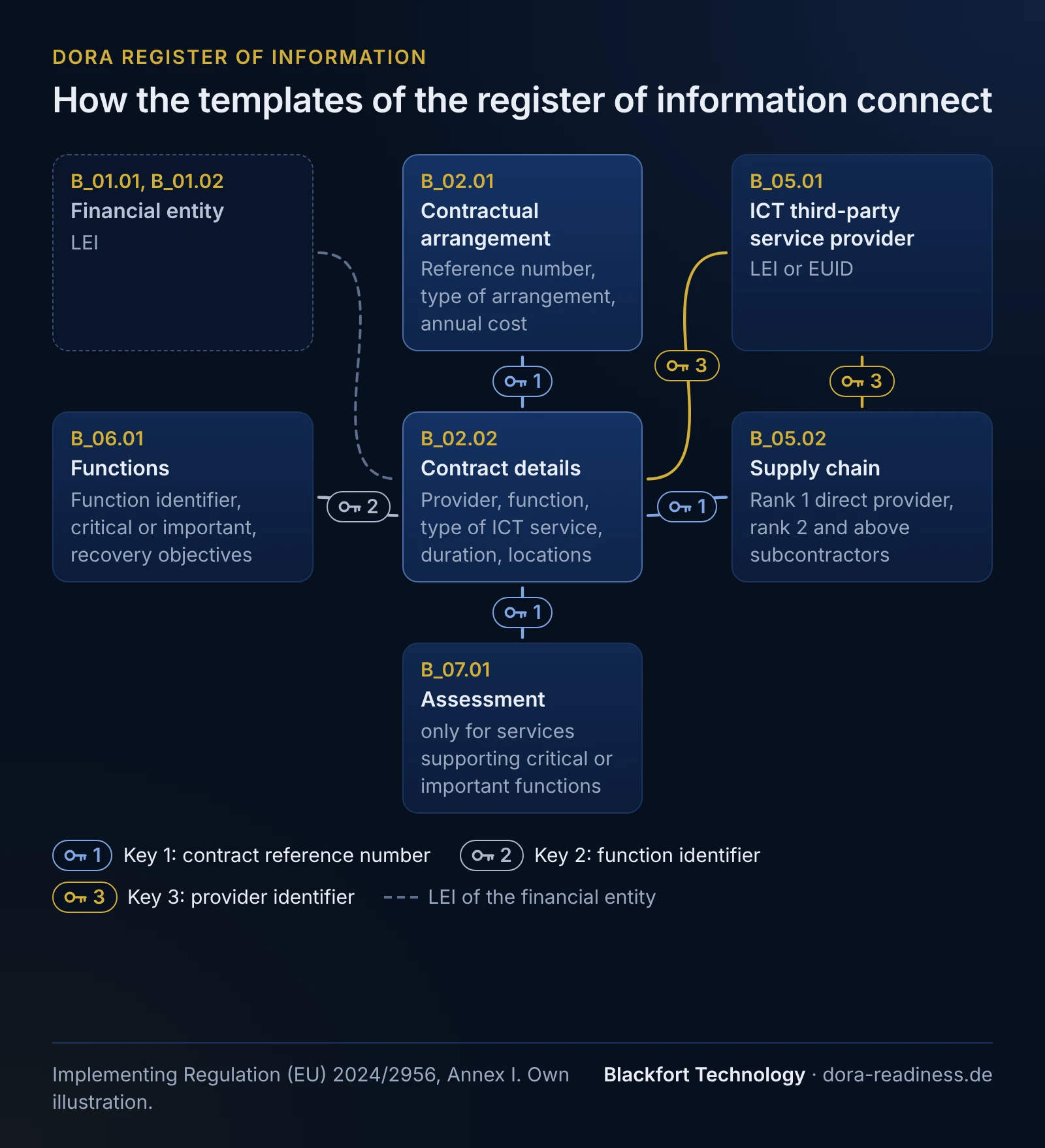
LEI, EUID and other identifiers
The financial entity identifies itself in the register with its LEI. ICT third-party service providers that are legal persons are identified with a valid and active LEI or with the European Unique Identifier (EUID), with both where both are available (Article 3(5) of the Implementing Regulation). For legal persons outside the EU only the LEI is permitted. Other identifiers such as commercial register or VAT identification numbers may only be used for individuals acting in a business capacity (Annex I, B_05.01.0020). BaFin does not accept dummy LEIs. You obtain the identifiers from the provider itself. For subcontractors in the chain of critical or important functions, you make sure through the direct provider that an LEI or EUID is available (Article 3(6)).
How is the critical or important function recorded per contract?
Article 28(3), second subparagraph, DORA requires arrangements covering critical or important functions to be distinguished from the others. In the register this happens through the function: template B_06.01 lists every function with its own identifier for each combination of LEI, licensed activity and function, with the assessment “yes”, “no” or “assessment not performed”, the date of the last assessment, and the recovery time objective and recovery point objective in hours. In B_02.02 each contractual arrangement refers through the function identifier to the function it supports. If an arrangement supports several functions, on our reading of the template it appears in several rows, one per function.
If the service supports a critical or important function, further fields become mandatory: notice periods for both parties in calendar days, governing law, country of provision, storage of data with location, sensitiveness of the data, level of reliance, plus the whole of template B_07.01 with substitutability, date of the last audit, exit plan, possibility of reintegration, impact of discontinuing and alternative providers. You decide beforehand which functions are critical or important. The method is shown on classifying critical or important functions.
Filling aid: one contract, completed
Fictitious example, not a client. Muster-Factoring GmbH (23 staff, EUR 61 million total assets, not a microenterprise) from the example on the function list obtains its core factoring system as software as a service. The software vendor runs it in a subcontractor’s data centre. Two critical or important functions run on the core system: purchase of receivables (F1) and accounts receivable (F3). The table shows the main fields for this contract. Replace placeholders in angle brackets with real identifiers, never with invented ones.
| Column | Field | Mandatory | Example value | Note |
|---|---|---|---|---|
| B_01.01.0010 | LEI of the entity maintaining the register | always | <LEI of Muster-Factoring GmbH> | 20 characters under ISO 17442, valid and active |
| B_01.01.0040 | type of financial entity | always | “credit institutions” or “other financial entity”, open, see the note below the table | selection from a fixed list |
| B_02.01.0010 | contractual arrangement reference number | always | MF-IKT-007 | assigned internally, never change, identical in all templates |
| B_02.01.0020 | type of contractual arrangement | always | standalone arrangement | for a framework contract with individual contracts: overarching and subsequent arrangements |
| B_02.01.0040 and 0050 | currency, annual cost | always | EUR, 96000 | expenses of the past year, in units, no double counting |
| B_02.02.0030 and 0040 | identification code of the provider, type of code | always | <LEI of the software vendor>, LEI | exactly as in B_05.01 |
| B_02.02.0050 | function identifier | always | F1, in a second row F3 | one row per supported function |
| B_02.02.0060 | type of ICT services | always | S19 | code from Annex III, S19 stands for SaaS |
| B_02.02.0070 and 0080 | start date, end date | always | 2023-04-01, 9999-12-31 | open-ended: 9999-12-31 |
| B_02.02.0100 and 0110 | notice period for the financial entity, notice period for the provider | for a critical or important function | 180, 365 | calendar days from receipt of the notice |
| B_02.02.0120 and 0130 | governing law, country of provision | for a critical or important function | DE, DE | country code under ISO 3166-1 alpha-2 |
| B_02.02.0140 and 0150 | storage of data, location of the data at rest (storage) | 0140 for a critical or important function, 0150 if 0140 is “Yes” | Yes, DE | one row for each further country of storage |
| B_02.02.0160 | location of management of the data (processing) | if the service processes data, regardless of the function | DE | one row for each further country of processing |
| B_02.02.0170 | sensitiveness of the data | for storage and a critical or important function | High | the highest applicable level |
| B_02.02.0180 | level of reliance | for a critical or important function | Full reliance | four levels from “not significant” to “full” |
| B_05.01.0050 to 0080 | name, name in Latin alphabet, type of person, country of headquarters | always | name as in the commercial register, the same, legal person, DE | once per provider, including the subcontractor |
| B_05.01.0110 | identification code of the ultimate parent undertaking | if the provider is not itself the parent | <LEI of the parent company> | without a group, repeat the provider’s own code |
| B_05.02.0020 | type of ICT services in the chain | always | S19, also in the row for rank 2 | all links in a chain provide the same type of service |
| B_05.02.0050 and 0060 | rank, recipient of the sub-contracted services | always, recipient from rank 2 | software vendor 1, data centre operator 2 with recipient <LEI of the software vendor> | enter the subcontractor’s identification code here as well |
| B_06.01.0010 to 0030 | function identifier, licensed activity, function name | always | F1, activity see the note below the table, purchase of receivables with purchase and limit checks | name as in your function list |
| B_06.01.0050 and 0070 | critical or important, date of the assessment | always | Yes, 2026-12-15 | date on which the management body adopted the function list (December 2026 in the example) |
| B_06.01.0080 and 0090 | recovery time objective, recovery point objective | always | 8, 1 | hours, under one hour “1”, not set “0” |
| B_06.01.0100 | impact of discontinuing the function | always | High | explain the meaning of the levels in B_99.01 |
| B_07.01.0050 and 0060 | substitutability, reason | for a critical or important function | highly complex substitutability, difficulties in relation to data migration | reason only for “not substitutable” or “highly complex substitutability” |
| B_07.01.0070 | date of the last audit | for a critical or important function | 9999-12-31 | no audit performed. Third-party certifications and the provider’s internal audit reports do not count here |
| B_07.01.0080 and 0090 | exit plan, reintegration | for a critical or important function | Yes, highly complex | exit plan per service |
| B_07.01.0100 and 0110 | impact of discontinuing, alternative providers | for a critical or important function | High, Yes | naming alternatives in B_07.01.0120 is optional |
Note for the KWG group: The selection list in B_01.01.0040 and the activities in Annex II follow the types of financial entity under Article 2 DORA. There is no separate option for institutions covered only through Section 1a(2a) KWG. Either “credit institutions” or “other financial entity” comes into question, and there is an argument for each reading. The Implementing Regulation intends “other financial entity” for parent undertakings that maintain the register at group level but are not themselves subject to the register duty because they do not fall under Article 2 DORA, such as financial holding companies, mixed financial holding companies or mixed-activity holding companies. Institutions under Section 1a(2a) KWG likewise do not fall under Article 2, but are themselves subject to the register duty through the KWG. The case is therefore only partly comparable, so “other financial entity” is supported only by analogy. “Credit institutions”, with the activities for credit institutions (Annex II, B_06.01.0020), is supported by the KWG, which applies DORA to these institutions “as if these institutions were CRR credit institutions” (our translation). We have not found a BaFin determination. Compare both fields with BaFin’s filling instructions and its sample completed Excel template, and ask BaFin if in doubt.
The column codes of template B_06.01 follow the corrigendum to the Implementing Regulation of 19 September 2025, which applies to the English text as well. It moved the columns from the assessment onwards forward by one: the assessment “critical or important” is in 0050, the reasons in 0060, the date of the assessment in 0070, the recovery objectives in 0080 and 0090, the impact of discontinuing in 0100. Documents using 0060 to 0110 follow the uncorrected text. Check the codes against the BaFin Excel template you use for submission.
The filling aid is also available as a file with the sheets filling aid, templates and checklist: Download the filling aid (Excel, xlsx, in German). It does not replace BaFin’s Excel template, which you use for submission.
How is the register submitted to BaFin?
| Step | What applies |
|---|---|
| Reference date and deadline | annually, data as of 31 December of the previous year, submission process completed in full and without errors by 31 March at the latest. BaFin announces on its website at the start of the year from when it accepts registers. |
| Channel | only through the reporting and publishing platform (MVP), specialist procedure “Digital Operational Resilience Act (DORA)”. Reporting staff must be authorised for it. |
| Format | xBRL file following the taxonomy of the European Supervisory Authorities, or BaFin’s Excel template in the prescribed structure. No taxonomy changes are planned for the 2027 cycle. |
| Test | possible at any time through the specialist procedure “TEST: Digital Operational Resilience Act (DORA)” |
| Validation | first by BaFin, then by the European Supervisory Authorities, up to 48 hours. The duty is only met once they too have accepted the register, visible in the MVP log. If it is rejected, upload the corrected register as a new submission before the deadline. |
| No response | If the submission stays in the status “in Verarbeitung (extern)” (in processing, external) for more than 48 hours, submit again and update the timestamp in the file name. |
| Data quality | At the beginning of April the European Supervisory Authorities send out data quality feedback, in 2026 for the first time and for about 90 percent of registers. It compares information from many entities and is not a content validation. Keep correct information and document the deviation internally, for example with a screenshot of the GLEIF entry. |
| Deadline missed | no late submission in the current cycle and no submission by email. The register is then deemed not submitted or not submitted correctly. |
| Changes during the year | enter in the register without delay, but submit only in the annual cycle or on request |
BaFin handles two further duties from Article 28(3) through the register or existing channels. It takes the number of new arrangements from the register itself, so no separate report is needed. Planned arrangements for critical or important functions, and functions that have become critical or important, you notify in a timely manner. If there is also a notifiable outsourcing, you continue to notify it through the MVP specialist procedure “Anzeige von Auslagerungen” (notification of outsourcing). BaFin announces on its website that the DORA notification is to be possible in the same form in future. Where there is no overlap, send BaFin’s Excel form by email to DORA-Informationsregister@bafin.de.
Open for the KWG group: Article 28 applies to it from 1 January 2027 (Section 1a(2a) with Section 65a(3) KWG). Whether it already submits a register as of 31 December 2026 in 2027, or for the first time in 2028 as of 31 December 2027, is not settled in any source we have read. We recommend keeping the register ready for submission from January 2027, making a test submission early and following BaFin’s announcement at the start of the year.
Typical validation errors
We have not analysed the validation rules of the European Supervisory Authorities themselves. The error patterns below come from BaFin’s guidance and the wording of the Implementing Regulation. BaFin also provides an overview of possible error codes with remedies.
| Error pattern | Cause | Remedy |
|---|---|---|
| Mandatory fields empty | In the 2024 dry run, the European Supervisory Authorities found, among other things, mandatory fields that had not been filled in. | Check the reporting option of each column, especially the fields that are only mandatory for critical or important functions. Complete the assessment in B_06.01 first. |
| Identifiers wrong or missing | According to BaFin, identifiers of financial entities and providers were often wrong or missing in the dry run. | Check LEIs against the GLEIF entry, see the section on identifiers |
| Error type 705 after a correction | According to BaFin, it occurred frequently in 2026 after entities had changed LEIs. The dependencies in the data model were not respected. | update a changed LEI everywhere it is used, include LEIs of providers and subcontractors in table 05.02 |
| Reference number differs | The contract has a different number in B_02.01 than in B_02.02, B_05.02 or B_07.01, for example after renaming | assign the reference number once and never change it |
| Date missing | open-ended contract without end date, audit never performed | enter 9999-12-31 in both cases |
Three typical gaps
| Gap | Cause | Effect | Remedy |
|---|---|---|---|
| Subcontractors by name only | The provider supplies a list of its subcontractors without LEI or EUID, and the contract does not oblige it to provide them. | The chain in B_05.01 and B_05.02 is incomplete for critical or important functions, and the submission fails or is late. | Request the subcontractors’ LEI or EUID at the next contract meeting and agree it as an ongoing delivery obligation, have this reviewed legally. |
| Recovery objectives reported as “0” | The business impact analysis (BIA) is not complete, and there are no adopted objectives for the functions. | For critical or important functions the register shows the supervisor “not set”, although both frameworks require objectives. | Adopt the BIA and objectives before the reference date, see ICT risk management and Article 16. |
| Register maintained only in March | The register is treated as a reporting project, and procurement and business units conclude contracts without an entry. | Changes are missing although they must be entered without delay. Notifications for new arrangements for critical or important functions are not made, and errors only surface shortly before the deadline. | Make the register entry a step in the procurement and contract process, test submission in January. |
How to assess and renegotiate contracts with ICT providers and secure them with exit strategies is covered on managing ICT third-party risk.
How we can help
For institutions moving to Article 16 and for entities under the full framework we start with the DORA gap analysis. It shows whether register, function list and contracts fit together and what is missing before the next reference date. Legal questions on contracts and individual cases are for you to clarify with your legal advisers.
Frequently asked questions
Do arrangements without a link to critical or important functions also go into the register?+
How do we record a framework contract with individual contracts?+
How often do we have to update the register?+
Do arrangements with intra-group ICT providers go into the register?+
Is the register of information the same as the outsourcing register?+
Read more
- Classifying critical or important functions under DORA
- ICT third-party risk under DORA: managing providers and Article 30 contracts
- DORA Article 16: the simplified ICT risk management framework
- ICT risk management under DORA: framework and DOR strategy
- DORA for ICT providers: what financial customers will ask
- DORA gap analysis: quick check, Article 16 and full framework
Sources
- Regulation (EU) 2022/2554 (DORA), Articles 3(21), 28(1) and (3) (retrieved 2026-11-06)
- Implementing Regulation (EU) 2024/2956 (standard templates for the register of information), Articles 2 to 6, Annexes I to III (retrieved 2026-11-06)
- Corrigendum of 19 September 2025 to Implementing Regulation (EU) 2024/2956 (OJ L 2025/90725), column codes B_06.01.0050 to 0100, B_05.01.0020, B_05.01.0090, B_07.01.0110, German version (retrieved 2026-11-06)
- BaFin: register of information and notification duties, in German (retrieved 2026-11-06)
- BaFin: article of 15 January 2025, DORA: register of information and notification duties, in German (retrieved 2026-11-06)
- BaFin: DORA FAQ, section on the register of information, in German (retrieved 2026-11-06)
- BaFin: supervisory notice of 21 August 2025 on the simplified ICT risk management framework, section 7, in German (retrieved 2026-11-06)
- German Banking Act (KWG), Sections 1a(2a) and 65a(3), unofficial version in German (retrieved 2026-11-06)
This content provides general technical and organisational information and does not constitute legal advice (no legal services within the meaning of the German RDG).