

Last updated: 2026-11-06
This page is for IT service providers with customers in the financial sector: managed service providers, software vendors, data centres, cloud and telecoms providers. Your customers apply either the full framework under Articles 5 to 15 DORA or the simplified framework under Article 16. For the requirements passed on to you, that makes little difference, because Articles 28 to 30 apply in both. The only exception in Germany is microenterprises among the institutions covered by section 1a(2a) of the German Banking Act (KWG), such as factoring and leasing firms, for which Articles 28 to 30 do not apply. Which framework a customer is in is explained on DORA applicability.
Does DORA apply to ICT providers?
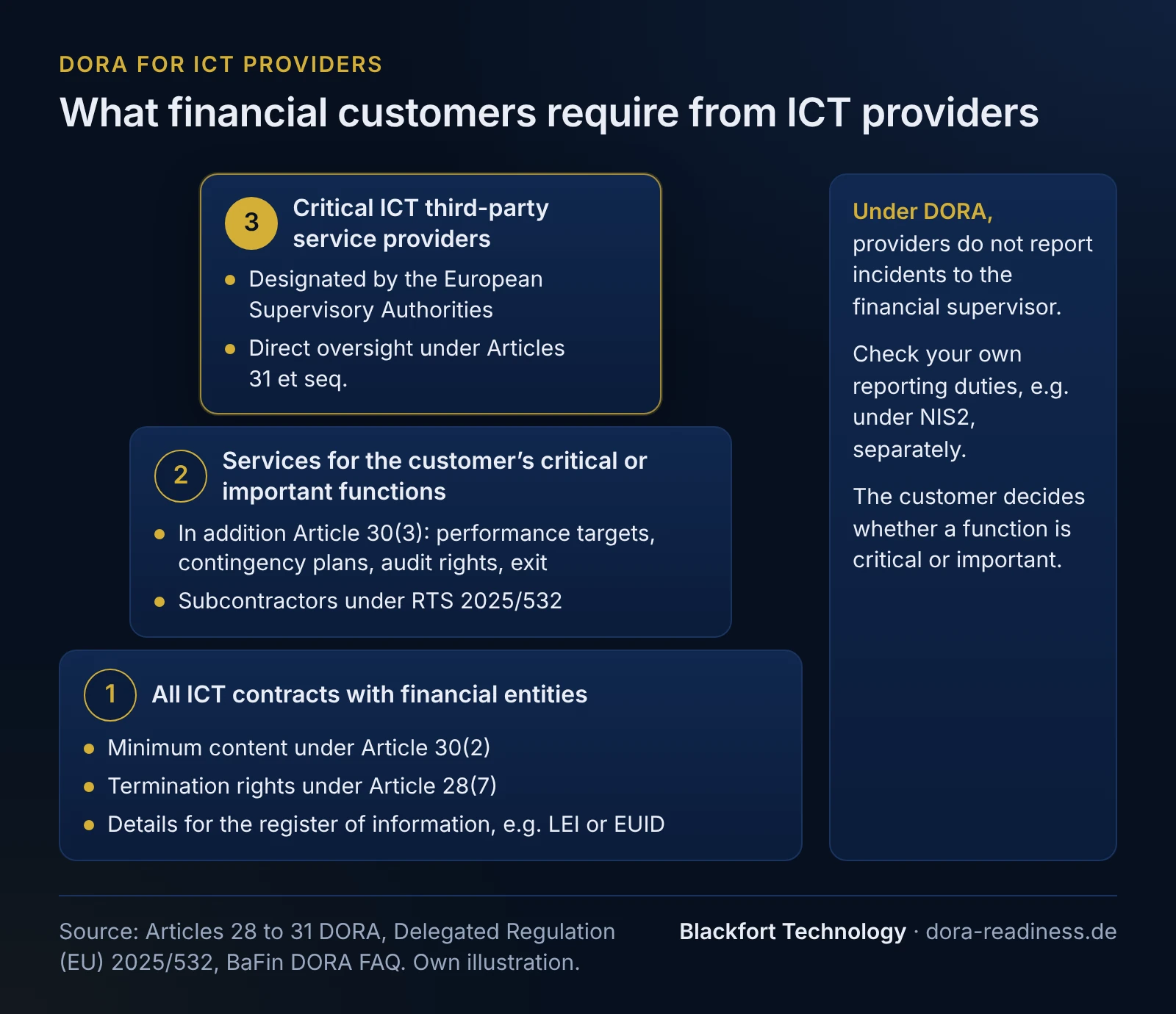
Not as a direct obligation, with one exception. ICT third-party service providers are listed in Article 2(1)(u) DORA but are not financial entities under Article 2(2). According to BaFin, the rules apply only to financial entities and affect ICT providers indirectly, because financial entities have to include certain requirements in their contracts. Providers have no incident reporting duty under DORA. If an incident at your end causes a major incident at a customer, the customer reports it. You may have reporting duties of your own under other laws, see below.
The exception is critical ICT third-party service providers. They are designated by the European Supervisory Authorities under Article 31 DORA and then fall under the oversight framework in Chapter V, Section II, with a Lead Overseer. The criteria are the systemic impact of a failure, the importance of the customers, their reliance for critical or important functions, and substitutability (Article 31(2)). The authorities designate annually on the basis of the registers of information and publish a list. Under Article 31(8), designation does not apply to intra-group providers, among others, or to providers serving financial entities in only one Member State where those entities are only active in that Member State. A provider that is designated is notified and must tell its financial customers (Article 31(5)). Financial entities may only use the services of a designated provider established in a third country if it has set up an EU subsidiary within twelve months following the designation (Article 31(12)).
The Regulation does not provide for a “DORA certificate” that a provider could obtain. What matters is the contract and the evidence behind it.
Are you an ICT provider under DORA?
An ICT third-party service provider is any undertaking providing ICT services (Article 3(19)). ICT services are digital and data services provided through ICT systems to internal or external users on an ongoing basis, including hardware as a service, excluding traditional analogue telephone services (Article 3(21)). BaFin expects financial entities to assess every third-party arrangement with an ICT element. Expect questions even if you never thought of your service as outsourcing:
| Provider | Typical service | What customers look at |
|---|---|---|
| Managed service provider | operation of servers, workplaces, network, backup, remote maintenance | privileged access, recovery, incident assistance |
| Software vendor | software as a service, maintenance and updates of business applications | data locations, subcontractors, data return, exit. Whether maintenance of software installed at the customer is an ICT service is the customer’s assessment |
| Data centre, colocation | space, power, cooling, infrastructure operation | often a subcontractor of another provider. The customer then asks the direct provider for identifier, location and audit rights |
| Cloud provider | infrastructure, platform, software as a service | locations, concentration risk, exit, audit rights. On C5 attestations see C5 and DORA (in German) |
| Telecoms provider | data lines, internet access, managed networks | availability, restoration, incident assistance. Only traditional analogue telephone services are excluded, data services are covered in our reading |
Where a supervised firm provides a regulated financial service, BaFin does not treat that service as an ICT service. BaFin treats intra-group providers in principle like external ones.
Which clauses will financial customers require?
Article 30 DORA sets the minimum content in two tiers. Whether your service supports a critical or important function at the customer is decided by the customer before signing (Article 28(4)(a)). That decides which tier applies:
| Applies to | Provision | What you commit to |
|---|---|---|
| all ICT contracts | Article 30(1) | contract in writing in one document, including the service level agreement |
| all ICT contracts | Article 30(2)(a) to (i) | complete service description stating whether subcontracting is permitted, locations of service provision, processing and storage with advance notice of changes, data protection and security, access to and return of data on insolvency, resolution, discontinuation or termination, service levels, incident assistance at no additional cost or at a cost determined ex ante, full cooperation with competent and resolution authorities, termination rights and minimum notice periods, participation in the customer’s security awareness and training |
| all ICT contracts | Article 28(7) | customer’s right to terminate for significant breach, for circumstances that may alter performance, for evidenced weaknesses in ICT risk management, and where the authority can no longer effectively supervise the customer as a result |
| services supporting critical or important functions | Article 30(3)(a) to (f) | precise performance targets, notice of developments that may affect your service, implementing and testing contingency plans, security measures, participation in the customer’s TLPT, unrestricted rights of access, inspection and audit for the customer, appointed third parties and the authority, exit strategy with a mandatory transition period |
| services supporting critical or important functions with subcontractors | Delegated Regulation (EU) 2025/532, Articles 3 to 6 | you can select, monitor and name subcontractors, pass on access and inspection rights to them, give timely notice of material changes with a period in which the customer can object, and do not implement them before |
BaFin expects many existing contracts to be renegotiated, including those without critical or important functions. There is no extended transition period, and no standard contractual clauses from public authorities exist yet. Two points leave room for manoeuvre. The contract may provide for alternative assurance levels if other clients’ rights are affected (Article 30(3)(e)(ii)). With customers that are microenterprises you may agree that an independent third party you appoint exercises the audit rights.
What goes into an evidence pack?
An evidence pack collects what every financial customer will ask for sooner or later, so you do not answer the same questions from scratch for each one. We recommend this structure:
- Service description per service, with the systems that deliver it.
- Location and subcontractor list with countries, legal entity identifier (LEI or EUID) and rank in the ICT service supply chain. Customers need this for their register of information.
- DORA contract addendum following Article 30(2) and (3), Article 28(7) and RTS 2025/532, with a version for all contracts and a supplement for critical or important functions.
- Security evidence: certificates with scope, current audit reports, a shareable version of your security concept.
- Contingency and test evidence: contingency plan, summary of the last restore test.
- Incident process: availability, time to first notice, content of your incident reports, cost of assistance.
- Exit support: export formats, transition period, data return procedure.
Certificates and audit reports help but do not fully replace the customer’s own checks. Under Delegated Regulation (EU) 2024/1773, Article 8(3), customers in the full framework that are not microenterprises may rely on them only under conditions and not solely in the longer term. They must, for example, check that the scope covers their systems and be able to request extensions.
Example: a managed service provider answers a customer questionnaire
Fictitious example, not a client. Muster-IT-Service GmbH has 40 staff and serves business customers in North Rhine-Westphalia. For Muster-Factoring GmbH (23 staff, EUR 61 million total assets, not a microenterprise) it runs servers, workplaces, firewall and backup. The servers sit in a rented data centre in Germany, and backup copies are also held by a storage provider in Germany. Muster-Factoring GmbH applies the Article 16 framework from 1 January 2027 and sends a questionnaire in November 2026. The questions derive from Articles 28 to 30 DORA, RTS 2025/532 and the register templates. The provider answers:
| Customer question | Provision | Provider’s answer | Evidence |
|---|---|---|---|
| Which services do you provide to us? | Art. 30(2)(a) | Operation of three servers and 25 workplaces, firewall, backup, remote maintenance. You decide which of these support critical or important functions. We have mapped each service to the applications running on it. | service description with mapping |
| What is your legal entity identifier? | ITS 2024/2956 Art. 3 | LEI and EUID, both active. LEIs of our two subcontractors are attached. | subcontractor list |
| Where is the service provided and where is data processed and stored? | Art. 30(2)(b) | Germany only. We give three months’ notice of any change of location. | location list, addendum |
| Do you use subcontractors? | Art. 30(2)(a), RTS 2025/532 Arts. 3 to 5 | Yes, the data centre operator (rank 2) and a storage provider for backup copies (rank 2). We give 60 days’ notice of material changes and do not implement them if you object. The storage provider currently grants audit reports only, not its own audit rights. Renegotiation runs until March 2027. | subcontractor list, negotiation status |
| Which security standards do you apply? | Art. 28(5), Art. 30(3)(c) | Information security management under ISO/IEC 27001, certificate covering operations and remote maintenance, not software development. | certificate with scope, summary of last audit report |
| Do you have contingency plans and how do you test them? | Art. 30(3)(c) | Contingency handbook for all managed customers, annual restore of one customer environment, most recently in September 2026. We offer a restore of your environment for your recovery exercise. | handbook extract, test record |
| How do you assist us with ICT incidents? | Art. 30(2)(f) | On-call service around the clock, first notice to your named contacts within one hour of detection, up to 20 hours of assistance per incident at no additional cost, beyond that at the agreed hourly rate. Reporting to BaFin is your duty. We supply the information. | incident process, contact list |
| Do you cooperate with the supervisor? | Art. 30(2)(g) | Yes, fully, including with persons appointed by the supervisor. | addendum |
| May we and the supervisor audit you? | Art. 30(3)(e) | Yes, with four weeks’ notice, at short notice where there is cause. Where other clients’ rights are affected, we propose a joint audit or an audit report as alternative assurance. | addendum |
| How do we get our data back if the contract ends or you fail? | Art. 30(2)(d), (3)(f) | Export of all data and backups in standard formats within 30 days, six-month transition period with continued operation, handover to your new provider. | exit handbook |
| Do your engineers attend our training? | Art. 30(2)(i) | Yes, once a year in your awareness session, evidenced by attendance list. | addendum |
| Will you take part in threat-led penetration testing? | Art. 30(3)(d) | TLPT does not apply to you under the KWG. We commit to it in the addendum nonetheless. | addendum |
| How is remote maintenance access protected? | RTS 2024/1774 Art. 33 (customer’s duty) | Personal accounts, second factor, access only after approval, sessions logged, monthly report to you. | access concept, sample report |
The answers show the form, they do not recommend particular deadlines or costs. What you can commit to depends on your operations and your own supplier contracts. Whether a wording is legally sufficient is for you and your customer to clarify with your legal advisers.
What other obligations do you have?
DORA governs only the relationship with your financial customers. As a provider you may have statutory duties of your own under other rules, including reporting duties, for example NIS2 and the German BSI Act, or the Telecommunications Act (TKG) as a telecoms provider. Assess these separately: for NIS2 at nis2-readiness.de, for security duties under the TKG at tkg-readiness.de (both in German).
Three typical gaps
| Gap | Cause | Effect | Remedy |
|---|---|---|---|
| Every financial customer negotiates its own DORA addendum | No addendum of your own, questionnaire answers are written afresh each time. | Different deadlines and commitments per customer that operations cannot keep. | One addendum following Article 30 with a supplement for critical or important functions, deviations only with reasons. |
| Commitments your own suppliers do not cover | Contracts with the data centre or cloud storage do not pass on audit and information rights. | The conditions of RTS 2025/532 Article 3 are not met, so the customer cannot permit the subcontracting or has to renegotiate. | Check and update supplier contracts before committing to customers, keep the subcontractor list with identifiers current. |
| Incident assistance only on a time-and-materials basis | Standard service agreement without rules for customer incidents. | Article 30(2)(f) is not met, and the customer receives information too late for its reporting deadlines. | Fix costs in advance, agree a time to first notice and named contacts. |
How we can help
There is a dedicated ICT provider variant of the DORA gap analysis: we compare your financial customers’ clauses and questionnaires with what you have and build the evidence pack with you. Scope and price are set after a scoping call. Legal review of your addendum stays with your legal advisers.
Frequently asked questions
Do we as a provider have to report ICT incidents to BaFin under DORA?+
Do we need an LEI?+
Can we refuse on-site audits by customers?+
Do customers under Article 16 ask less of us?+
How do we know whether we will be designated as a critical ICT provider?+
Read more
- ICT third-party risk under DORA: managing providers and Article 30 contracts
- DORA register of information: structure, mandatory fields, submission
- Classifying critical or important functions under DORA
- DORA scope: who does DORA apply to, and which framework?
- DORA gap analysis: quick check, Article 16 and full framework
Sources
- Regulation (EU) 2022/2554 (DORA), Articles 2, 3(19), (21), (23), 28 to 31 (retrieved 2026-11-06)
- Delegated Regulation (EU) 2025/532 (subcontracting), Articles 3 to 6 (retrieved 2026-11-06)
- Delegated Regulation (EU) 2024/1773 (policy on ICT services), Article 8 (retrieved 2026-11-06)
- Implementing Regulation (EU) 2024/2956 (register of information), Articles 2 and 3 (retrieved 2026-11-06)
- BaFin: DORA FAQ (oversight framework, third-party risk, reporting, register of information), in German (retrieved 2026-11-06)
- BaFin: supervisory notice of 21 August 2025 on the simplified ICT risk management framework, section 7, in German (retrieved 2026-11-06)
- BaFin: register of information and notification duties, in German (retrieved 2026-11-06)
- German Banking Act (KWG), section 1a(2a), unofficial version in German (retrieved 2026-11-06)
This content provides general technical and organisational information and does not constitute legal advice (no legal services within the meaning of the German RDG).