

Last updated: 2026-11-06
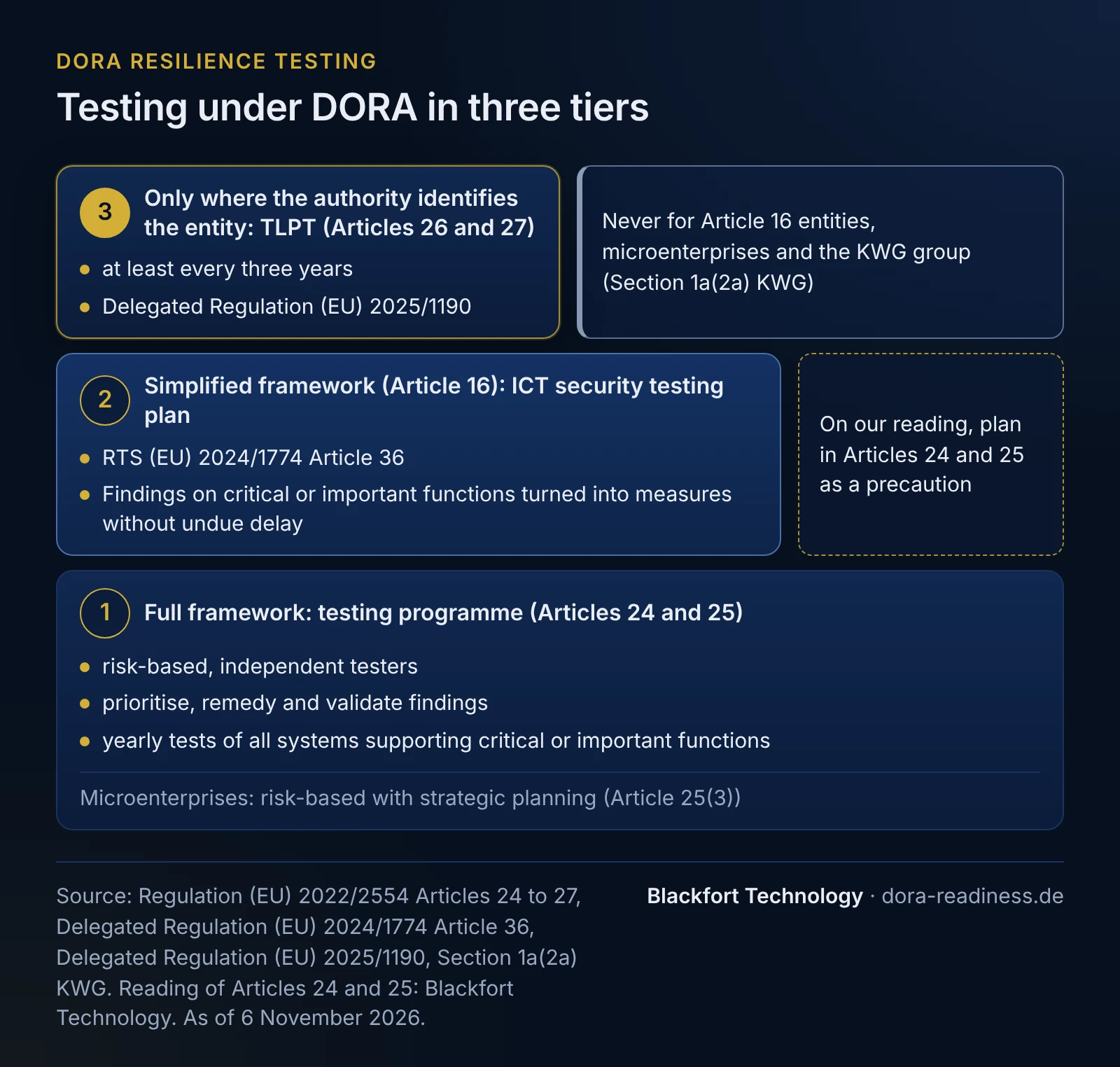
This page applies to both frameworks: to financial entities under the full framework of Articles 5 to 15 DORA and to entities under the simplified framework of Article 16, including, from 1 January 2027, the institutions under Section 1a(2a) of the German Banking Act (KWG) (here: KWG group) such as factoring and leasing firms. Which framework applies to you is covered on our page DORA applicability. Chapter IV of the Regulation governs testing in four articles: Articles 24 and 25 for the testing programme, Articles 26 and 27 for TLPT.
What does Article 24 DORA require of the testing programme?
A programme that identifies weaknesses, deficiencies and gaps in digital operational resilience and triggers corrective measures. It is an integral part of the ICT risk management framework and is established, maintained and reviewed (Article 24(1)). The six paragraphs at a glance:
| Paragraph | Obligation | Microenterprises |
|---|---|---|
| (1) | sound and comprehensive testing programme as part of the framework, taking into account the criteria in Article 4(2) | not expressly, they test under Article 25(3) |
| (2) | the programme includes assessments, tests, methodologies, practices and tools under Articles 25 and 26 | describes the content, no separate obligation |
| (3) | risk-based approach: how ICT risk is evolving, the entity’s own risks, criticality of information assets and services | not expressly |
| (4) | tests by independent parties, whether internal or external, with sufficient resources and no conflicts of interest for internal testers | not expressly |
| (5) | procedures to prioritise, classify and remedy all findings, and internal validation that they are fully addressed | not expressly |
| (6) | appropriate tests at least yearly of all ICT systems and applications supporting critical or important functions | not expressly |
Which functions are critical or important is set by your list of functions. Without it, paragraph 6 cannot be planned.
Which tests does Article 25 list?
Article 25(1) lists the tests as examples (“such as”). Which of them you carry out and how often depends on your risk profile. For some of them, Delegated Regulation (EU) 2024/1774 (“RTS” below) sets more specific requirements under the full framework:
| Test under Article 25(1) | What it checks | More specific requirement in the RTS (full framework) |
|---|---|---|
| vulnerability assessments and scans | known vulnerabilities in systems and applications | automated scans of assets supporting critical or important functions at least weekly (RTS Article 10(2)) |
| open source analyses | libraries in use and their vulnerabilities | tracking of third-party libraries (RTS Article 10(2)(d)) |
| network security assessments | segmentation, rules, external access | - |
| gap analyses | distance between requirement and implementation | - |
| physical security reviews | access, premises, environment | - |
| questionnaires and scanning software solutions | security of purchased software | - |
| source code reviews where feasible | errors and vulnerabilities in the code | static and dynamic testing, security of internet-exposed systems (RTS Article 16(3)) |
| scenario-based tests | response to a simulated incident | - |
| compatibility, performance and end-to-end testing | interaction, load, the whole process chain | capacity and performance management (RTS Article 9) |
| penetration testing | whether an attacker can exploit vulnerabilities | - |
DORA sets no fixed frequency for penetration tests.
What does “test at least yearly” under Article 24(6) mean?
Every ICT system and application that supports a critical or important function is tested appropriately at least once a year, even if a service provider runs it. DORA does not specify which test. In our assessment it should match the risk of the system, for example a penetration test for a customer portal, or an end-to-end or performance test for a processing chain. Whether Article 24(6) applies under the simplified framework is open (see below).
How much testing is appropriate?
That depends on your size, overall risk profile and the complexity of your business. For Chapter IV, the principle of proportionality applies only where the provisions expressly provide for it (Article 4(2)). Articles 24 and 25 do: the programme takes the criteria from Article 4(2) into account, the approach is risk-based and the tests are “appropriate”.
Microenterprises test under Article 25(3): they combine a risk-based approach with strategic planning of ICT testing and weigh resources and time against urgency, risk and criticality. Paragraphs 1 and 3 to 6 of Article 24 are not addressed to them. Whether your firm is a microenterprise is checked against both size criteria, see DORA applicability.
What applies under the simplified framework of Article 16?
An ICT security testing plan under RTS Article 36. It validates the effectiveness of the security measures under RTS Articles 33 to 35, 37 and 38 and considers the threats and vulnerabilities identified in risk management under RTS Article 31 (paragraph 1). Testing takes into account the overall risk profile of the ICT assets (paragraph 2). You turn findings on systems supporting critical or important functions into updated measures without undue delay (paragraph 3). The RTS also requires automated vulnerability scanning (RTS Article 34(d)), but sets no fixed frequency for it as under the full framework.
Articles 24 and 25 contain no exemption for Article 16 entities. That the testing programme therefore also applies here is our reading. Reasoning, counter-argument and recommendation are on our page DORA Article 16: the simplified framework. The yearly tests of the business continuity plans under RTS Article 40 are covered on our page ICT business continuity.
TLPT: who must carry out threat-led penetration testing
Only financial entities that the authority identifies for it. They carry out TLPT at least every three years, and the authority may adjust the frequency based on the risk profile (Article 26(1)). Entities under Article 16(1) and microenterprises are excluded. For the KWG group, Section 1a(2a) sentence 2 no. 2 KWG expressly excludes Articles 26 and 27, so TLPT never applies to them.
Who is identified: The authority assesses the impact on the financial sector, financial stability concerns and the ICT risk profile (Article 26(8)). Delegated Regulation (EU) 2025/1190 (RTS on TLPT) specifies this in Article 2(1) with criteria such as size, interconnectedness, substitutability, threat situation and maturity of security controls. Under Article 2(2), the authority as a rule requires TLPT from systemically important credit institutions, large payment and e-money institutions, central securities depositories, central counterparties, certain trading venues and large insurers, unless its assessment concludes otherwise.
Who is responsible in Germany: For institutions under the KWG, BaFin cooperates with the Deutsche Bundesbank on the tasks under Articles 26 and 27, and the Bundesbank carries out the operational tasks (Section 6(1g) KWG). Under recital 1 of the RTS on TLPT, entities required to test may apply the TIBER-EU framework or a national implementation such as the Bundesbank’s TIBER-DE, provided these are consistent with Articles 26 and 27 DORA and the RTS.
How TLPT works:
- Preparation: the management body approves the scope specification document (RTS on TLPT Article 9(6)), and the authority validates the scope. Several or all critical or important functions are tested on live production systems (Article 26(2) DORA).
- Threat intelligence and testing: at least three scenarios (RTS on TLPT Article 10(3)), an active red team testing phase of at least twelve weeks (Article 11(5) RTS (EU) 2025/1190).
- Closure: red team and blue team reports, purple teaming (RTS on TLPT Article 12), a remediation plan (Article 13 RTS (EU) 2025/1190) and the attestation from the authority (Article 26(7) DORA).
Testers must meet the requirements of Article 27, and additional rules apply to internal testers (Article 26(8), see FAQ). You contractually oblige service providers that support critical or important functions to participate in your TLPT (Article 30(3)(d)).
Example: 2027 test plan of Muster-Kreditbank AG
Fictitious example, not a client. Muster-Kreditbank AG is the CRR credit institution from the example on our page ICT risk management: 140 employees, full framework, a data centre service provider runs the core banking system with online banking, and a managed service provider (MSP) runs workstations and the network. Added for this example: an online loan application process developed in-house. The critical or important functions are payments, credit decisions and disbursement, and regulatory reporting. The bank does not plan TLPT: it belongs to none of the groups under Article 2(2) of the RTS on TLPT and has not been identified.
| Period | Test under Article 25 | Subject | Performed by | Basis | Evidence |
|---|---|---|---|---|---|
| weekly | automated vulnerability scans | all assets of the three critical or important functions in the bank’s own network, other assets monthly | IT operations, evaluated by information security | Article 25(1), RTS Article 10(2) | scan reports, finding tickets |
| with every build | open source analysis | libraries of the loan application process | development, tool in the build pipeline | RTS Article 10(2)(d) | dependency list with findings |
| before every release | static and dynamic source code review | loan application process | static in development, dynamic by the test team outside development | RTS Article 16(3) | review report per release |
| February | external penetration test | online banking and loan application process | external provider, online banking with approval from the data centre | Article 24(4) and (6) | report, retest |
| March | network security assessment | segmentation, firewall rules, remote access of the MSP | information security, not network operations | Article 25(1) | assessment, rule review record |
| April | scenario-based test | failure of the data centre for payments | together with the test of the business continuity plan | Article 25(1), Article 11(6) | test record |
| May | physical security review | server room and network distribution rooms at head office | facility management with information security | Article 25(1) | inspection report |
| June | gap analysis | security policies against RTS Title II | ICT risk control function | Article 25(1) | comparison list |
| at release changes, twice a year | compatibility test | core banking system with interfaces to reporting and payments | data centre, acceptance by the business units | Article 25(1) | acceptance record |
| September | performance test | payments at month-end peak load | data centre with IT operations | Article 25(1), RTS Article 9 | load test record |
| September | end-to-end test | loan application through disbursement to receipt in reporting | credit business unit with IT operations | Article 25(1), Article 24(6) | test case record |
| October | questionnaire and scan of software solutions | reporting software, evidence from the data centre | IT operations with outsourcing management | Article 25(1) | evaluated questionnaire |
| November | internal penetration test | directory service and workstations at the MSP | second external provider | Article 24(4) | report, retest |
| December | evaluation and review of the programme | coverage, open findings, 2028 plan | ICT risk control function, report to the management board | Article 24(1) | annual report |
The bank checks coverage under Article 24(6) in a column of its list of functions: each of the three functions is covered by a suitable test at least once a year. For findings under Article 24(5) it uses four classes. The deadlines are example values, DORA sets none:
| Class | Example | Deadline for remediation | Validation |
|---|---|---|---|
| critical | exploitable vulnerability in online banking | immediately, within 7 days at the latest | retest by the tester |
| high | missing patch on a server supporting a critical or important function | 30 days | new scan |
| medium | overly broad firewall rule | 90 days | rule review |
| low | outdated software with no known exploit | next maintenance window | sample check |
If a deadline is missed, the management board decides on an exception or escalation. Under the full framework, RTS Article 10(4)(d) also requires deadlines and escalation for patches.
Three typical gaps
| Gap | Cause | Effect | Remedy |
|---|---|---|---|
| Systems at the service provider missing from the test plan | Only the bank’s own network is tested, while the core system runs at the data centre. | The very systems supporting critical or important functions remain untested, and Article 24(6) is not evidenced. | Set out testing rights and test reports in the contract and coordinate tests with the provider, see Managing ICT third-party service providers. |
| Testers review their own system | The administrator who runs the firewall also assesses its rules. | The independence required by Article 24(4) is missing, and findings against one’s own work are easily overlooked. | Assign tests to a person or unit outside operations or outsource them, and record the responsibility in the programme. |
| Findings closed without retest | The ticket is closed as soon as operations report the fix. | Nobody checks whether the vulnerability is really gone. The internal validation under Article 24(5) is missing. | Close only after a retest, new scan or sample check, depending on the finding class. |
How we help
For entities under the full framework, the DORA gap analysis shows where your testing programme stands against Articles 24 and 25 and the RTS. Institutions of the KWG group moving from BAIT (BaFin’s supervisory requirements for IT in banks) on 1 January 2027 implement the test plan under RTS Article 36 in the transition from BAIT to Article 16. Other institutions under the simplified framework, such as small investment firms, small IORPs or insurance holding companies, start with the Article 16 gap analysis. We offer penetration tests under Article 25 (not TLPT under Article 26) on our company page on penetration testing.
Frequently asked questions
Do penetration tests under DORA have to come from an external provider?+
Is there a list of approved TLPT testers?+
Does our IT service provider’s test report count towards our testing programme?+
Can we take part in TIBER-DE voluntarily without being identified for TLPT?+
Read more
- DORA Article 16: the simplified ICT risk management framework
- DORA business continuity: ICT continuity plan and backup
- Classifying critical or important functions under DORA
- ICT risk management under DORA: framework and DOR strategy
- DORA gap analysis: quick check, Article 16 and full framework
- DORA Article 16 transition: moving from BAIT to the simplified framework
Sources
- Regulation (EU) 2022/2554 (DORA), Articles 4, 24 to 28, 30, German version (retrieved 2026-11-06)
- Delegated Regulation (EU) 2024/1774 (RTS on ICT risk management), Articles 9, 10, 16, 34, 36, German version (retrieved 2026-11-06)
- Delegated Regulation (EU) 2025/1190 (RTS on TLPT), recital 1, Articles 2, 9 to 14, German version (retrieved 2026-11-06)
- German Banking Act (KWG), Section 1a(2a) (unofficial version, in German) (retrieved 2026-11-06)
- German Banking Act (KWG), Section 6(1g) (unofficial version, in German) (retrieved 2026-11-06)
- BaFin: DORA FAQs, section on threat-led penetration testing (TLPT), in German (retrieved 2026-11-06)
- BaFin: supervisory notice of 21 August 2025 on implementing DORA with the simplified ICT risk management framework, sections 4.4 and 5.2, in German (retrieved 2026-11-06)
- Deutsche Bundesbank: TIBER-DE, in German (retrieved 2026-11-06)
This content provides general technical and organisational information and does not constitute legal advice (no legal services within the meaning of the German RDG).