

Last updated: 2026-11-06
The obligations that apply to all groups under the simplified framework, with an evidence matrix and a roadmap, are set out on the page on DORA Article 16. This page covers what only affects IORPs: how size is counted, what follows for each size band, and how BaFin’s Minimum Requirements for the System of Governance of IORPs (MaGo for IORPs) stand alongside DORA.
Which institutions are meant?
IORPs are financial entities under Article 2(1)(p) DORA. For the term, Article 3(52) DORA refers to Article 6(1) of the IORP Directive (EU) 2016/2341. In Germany these are Pensionskassen (Section 232 of the Insurance Supervision Act, VAG) and Pensionsfonds (Section 236 VAG). BaFin covers both in Circular 08/2020 (VA), the MaGo for IORPs, whose scope includes all Pensionskassen and Pensionsfonds under its supervision (margin no. 3).
How are members counted?
Across all pension schemes of the institution together: Article 2(3)(c) and Article 3(53) DORA both refer to schemes which together have a given number of members “in total”. DORA does not define the member itself. The IORP Directive defines a member in Article 6(5) as a person whose past or current occupational activities entitle or will entitle them to retirement benefits, expressly excluding beneficiaries (point 6) and prospective members (point 7). DORA uses the same term as the directive, “members” in English and “Versorgungsanwärter” in German. On our reading, active and deferred members therefore count, pensioners do not. Because DORA does not say so itself, an IORP close to a threshold should have this reading confirmed by a lawyer. The threshold of 100 matches the one in Article 5 of the IORP Directive, under which Member States may exempt small IORPs in whole or in part.
What applies up to 15, at 16-99 and from 100 members?
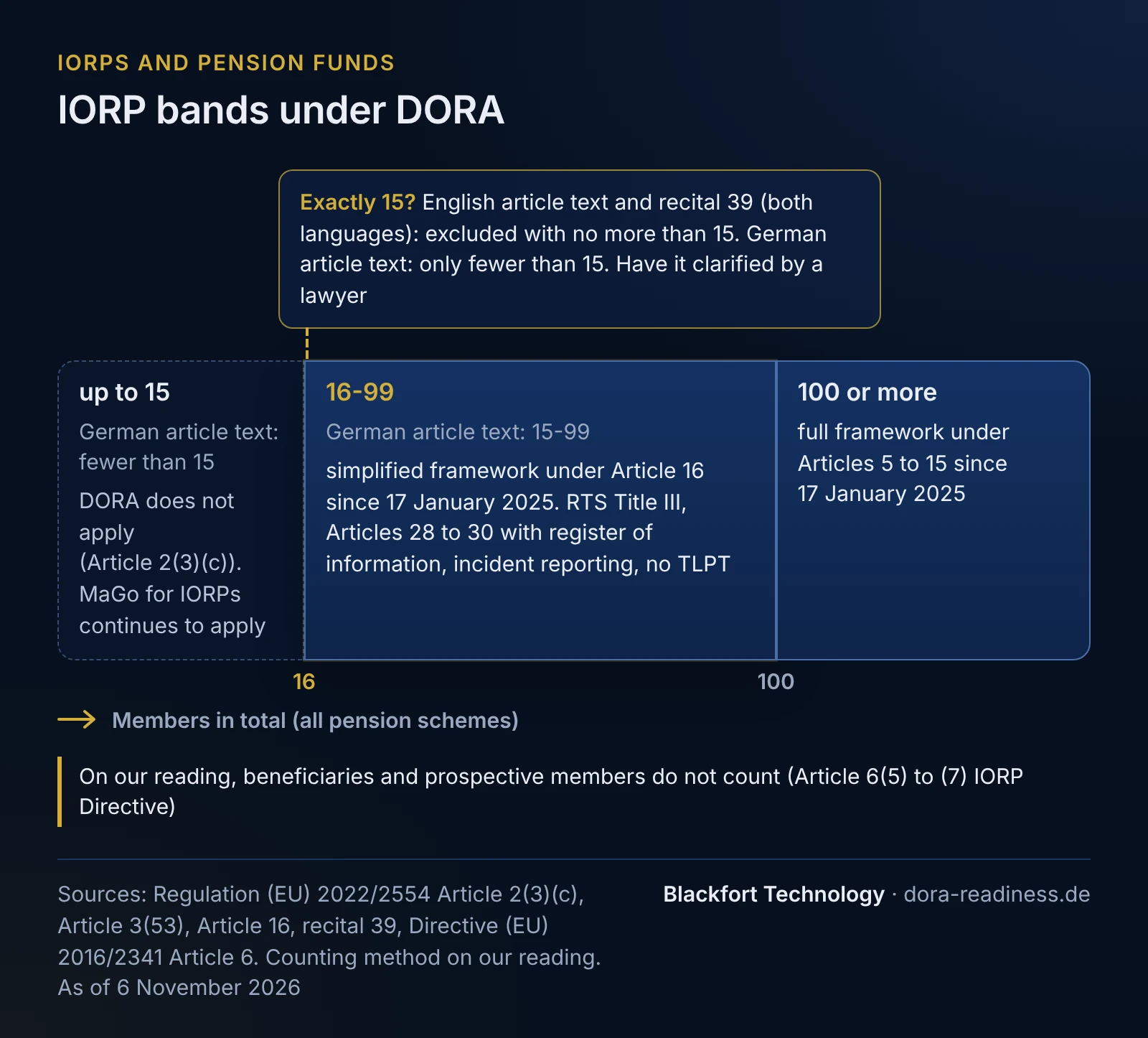
The bands follow from Article 2(3)(c), Article 3(53) and Article 16(1) DORA. In table 1 of its supervisory notice of 21 August 2025, BaFin assigns small IORPs to Article 16 under DORA itself.
| Members in total | DORA | What follows |
|---|---|---|
| up to 15 (German article text: fewer than 15) | does not apply (Article 2(3)(c)) | no DORA obligations. MaGo for IORPs continues to apply, and according to BaFin ICT risks must still be handled appropriately as part of a proper business organisation |
| 16-99 (German article text: 15-99), small IORP under Article 3(53) | simplified framework under Article 16 since 17 January 2025 | RTS (EU) 2024/1774 Title III, Articles 28 to 30 with register of information, incident reporting under Chapter III, no TLPT (Article 26(1)), testing programme under Articles 24 and 25 on our reading |
| 100 or more | full framework under Articles 5 to 15 since 17 January 2025 | RTS Title II with digital operational resilience strategy, ICT risk control function and the other requirements, see ICT risk management under the full framework |
The language versions differ at exactly 15 members: the English article text and recital 39 in both languages exclude IORPs with no more than 15 members, the German article text only those with fewer than 15. The reasoning is on the page on DORA applicability. An IORP with exactly 15 members should have the question clarified by a lawyer.
What does Article 16 mean for a small IORP?
The same as for the other Article 16 groups. Here too the RTS requires a policy, a list of functions with a business impact analysis, recovery objectives, logging and a business continuity plan, set out in detail on the page on DORA Article 16. For IORPs, two points follow from their legal basis:
- No transition period. Small IORPs fall under Article 16 directly under DORA, since 17 January 2025. The dates for the KWG group (1 January 2027) do not apply to them.
- Third parties without a microenterprise exemption. Articles 28 to 30 and the register of information also apply to an IORP that is a microenterprise under Article 3(60). The exemption in Section 1a(2a) sentence 2 no. 3 of the German Banking Act (KWG) concerns only the institutions under that provision (the KWG group). You can check whether an IORP is a microenterprise with headcount and balance sheet total as described on the page on DORA applicability.
Like all entities referred to in Article 16(1) DORA, small IORPs do not aggregate recurring minor incidents under Article 8(2) of Delegated Regulation 2024/1772. Classification and deadlines are covered on the page on reporting ICT-related incidents.
How do DORA and MaGo for IORPs relate?
They apply side by side. Pensionskassen and Pensionsfonds are subject to MaGo for IORPs, Circular 08/2020 (VA), in force since 1 June 2021. The MaGo for insurance undertakings under Solvency II, Circular 09/2025 (VA), expressly does not apply to Pensionskassen (margin no. 2). How that circular relates to DORA is described on the page on DORA for insurers. For IORPs, two chapters of MaGo for IORPs are particularly close to DORA:
| MaGo for IORPs | DORA | What this means in practice |
|---|---|---|
| Chapter 12 outsourcing, assessment of important functions and pension activities (margin no. 225) | Articles 28 to 30, classification of critical or important functions under Article 3(22) | BaFin sees the sectoral outsourcing rules as applying in parallel to DORA and complementing it (supervisory notice, section 7.1). The two assessments are not identical, so give separate reasons for each. The mandatory contract terms under Article 30 also apply to contracts that are not an outsourcing of an important function or pension activity under the VAG (section 7.3 with footnote 20). |
| Chapter 13 emergency management, adopted by the entire management board, with test runs and exercises (margin nos. 266, 267) | Article 16(1)(f) and (g), RTS Articles 39 and 40 | Existing emergency management is the basis for the ICT business continuity plan. What RTS Article 39 requires in addition, such as recovery objectives, is set out on the page on DORA Article 16. |
None of these obligations replaces the other. If your emergency planning under MaGo for IORPs is already in good shape, keep it and add the ICT parts that the RTS requires.
Example: classification record of an IORP
Fictitious example, not a client. Pensionskasse der Muster-Werke VVaG is the company pension fund of a mechanical engineering company. It has three employees of its own. Administration and IT are provided by the sponsoring undertaking. The management board records the DORA classification as at the reference date:
| Check | Value or finding | Evidence | Result |
|---|---|---|---|
| IORP under Article 2(1)(p), Article 3(52) DORA | Pensionskasse under Section 232 VAG, supervised by BaFin | authorisation, articles of association | yes |
| pension schemes | two tariff schemes, counted together | business plan | counted across both |
| members | 61 active and 23 deferred members with entitlements, 84 in total | member records, reference date 31 December 2025 | 84 |
| not counted (our reading) | 142 beneficiaries, 30 prospective members at the sponsoring undertaking | member records | reading confirmed by a lawyer on 15 October 2026 |
| exemption under Article 2(3)(c) | 84, so neither in the exempt band nor the borderline case of 15 | - | does not apply |
| small IORP under Article 3(53) | 84, so fewer than 100 | - | yes |
| microenterprise under Article 3(60) | 3 employees, balance sheet total EUR 48 million, annual turnover above EUR 2 million | financial statements 2025 | no |
| result | simplified framework under Article 16 since 17 January 2025, Articles 28 to 30 with register of information, incident reporting under Chapter III, no TLPT. MaGo for IORPs applies alongside | Article 16 | |
| consequence for third parties | IT services of the sponsoring undertaking are ICT services under Article 3(21) (our assessment): contract with terms under Article 30, entry in the register of information, plus outsourcing assessment under Chapter 12 MaGo for IORPs | ||
| triggers for a new check | more than 90 members (internal warning threshold), new tariff scheme or takeover of a portfolio, change of administrator, annually at the balance sheet date | ||
The record shows why the counting method matters: including beneficiaries, the fund would count 226 persons and fall under the full framework. That is why the record states who was counted, on which reading, and who confirmed it. All figures and dates are invented, the warning threshold is our recommendation.
Three typical gaps at small IORPs
| Gap | Cause | Effect | Remedy |
|---|---|---|---|
| counting method not recorded | the portfolio statistics show “insured persons” in total, members and beneficiaries are not separated | the framework is not evidenced, near 15 or 100 the wrong framework may be applied | count by category as at the reference date in the classification record, have the reading confirmed by a lawyer, repeat annually |
| only outsourcing under the VAG checked | the DORA inventory relies on the list of outsourcing arrangements under MaGo for IORPs | ICT contracts without an important function are missing from the register and lack the mandatory terms under Article 30 | capture all ICT services under Article 3(21), use the outsourcing list as a starting point, not as a boundary |
| services of the sponsoring undertaking without a contract under Article 30 | IT runs under an agency agreement or a service level agreement with the sponsoring undertaking that was never checked against DORA | mandatory terms, audit and access rights and exit rules are missing for precisely the most important provider | add an annex under Article 30 to the agreement, with legal advice, and list the sponsoring undertaking in the register |
Gaps and remedies are our professional assessment based on the wording of DORA, RTS, MaGo for IORPs and the supervisory notice. The example is entirely fictitious. This assessment is general information and does not replace legal advice in an individual case.
How we support you
Small IORPs do not come from BAIT (BaFin’s supervisory requirements for IT in banks), so the Article 16 gap analysis is the right starting point for them: it checks the classification record, documents and evidence against the evidence matrix and delivers an action plan that takes existing MaGo documentation into account. Scope and price are on the page on DORA gap analysis.
Frequently asked questions
Does this page also apply to Pensionsfonds?+
What happens if we grow beyond 100 members?+
Who reports an incident if the sponsoring undertaking runs our IT?+
Does NIS2 apply to Pensionskassen?+
Read more
- DORA Article 16: the simplified ICT risk management framework
- DORA scope: who does DORA apply to, and which framework?
- VAIT and DORA for insurers: mapping, MaGo and transition plan
- DORA register of information: structure, mandatory fields, submission
- DORA incident reporting: classifying and reporting ICT-related incidents
- DORA gap analysis: quick check, Article 16 and full framework
Sources
- Regulation (EU) 2022/2554 (DORA), German version, Articles 2, 3(52), (53) and (60), Articles 16, 26, 28-30, recital 39 (retrieved 2026-11-06)
- Regulation (EU) 2022/2554 (DORA), English version, Article 2(3)(c), Article 3(53), recital 39 (retrieved 2026-11-06)
- Directive (EU) 2016/2341 (IORP Directive), Articles 5 and 6 (retrieved 2026-11-06)
- Delegated Regulation (EU) 2024/1774 (RTS on ICT risk management), Title III Articles 28-41 (retrieved 2026-11-06)
- Delegated Regulation (EU) 2024/1772 (classification of incidents), Article 8(2) (retrieved 2026-11-06)
- BaFin: Circular 08/2020 (VA), Minimum Requirements for the System of Governance of Institutions for Occupational Retirement Provision (MaGo for IORPs), in German (retrieved 2026-11-06)
- BaFin: supervisory notice of 21 August 2025 on the simplified ICT risk management framework (Article 16 DORA), sections 1 and 7, in German (retrieved 2026-11-06)
- German Insurance Supervision Act (VAG), Section 232 Pensionskassen (unofficial version, in German) (retrieved 2026-11-06)
- German Insurance Supervision Act (VAG), Section 236 Pensionsfonds (unofficial version, in German) (retrieved 2026-11-06)
- BSI Act (BSIG), Annex 1 (unofficial version, in German) (retrieved 2026-11-06)
This content provides general technical and organisational information and does not constitute legal advice (no legal services within the meaning of the German RDG).