

Last updated: 2026-11-06
What counts as level 2, and how binding is it?
Level 2 consists of the legal acts with which the Commission supplements DORA on the basis of specific empowerments in the regulation. Delegated regulations and implementing regulations apply directly, just like DORA. What RTS and ITS are and which acts matter most to most financial entities is covered in the legal overview on the page DORA regulation. This page adds the complete list with official reference, related articles and framework.
BaFin, the German financial supervisor, does not issue its own circulars specifying DORA. The reason is also given on the page DORA regulation. Alongside the regulations there are two joint guidelines of the European Supervisory Authorities (ESAs). How binding they are is answered in the questions below.
How did we check the list?
On 6 November 2026, we queried the Official Journal of the EU (Cellar database) for all legal acts based on DORA. The result is exactly the twelve acts below. We read title, date, publication and empowerment in the German official text. No amending act is recorded for DORA or the twelve acts. There are corrigenda, however, and four of them affect the German version (table further below).
All delegated and implementing regulations enter into force on the twentieth day after their publication in the Official Journal. Delegated Regulation 2024/1502 contains an exception with a later date: the lead overseer applies sub-criterion 1.4 only from 16 January 2025.
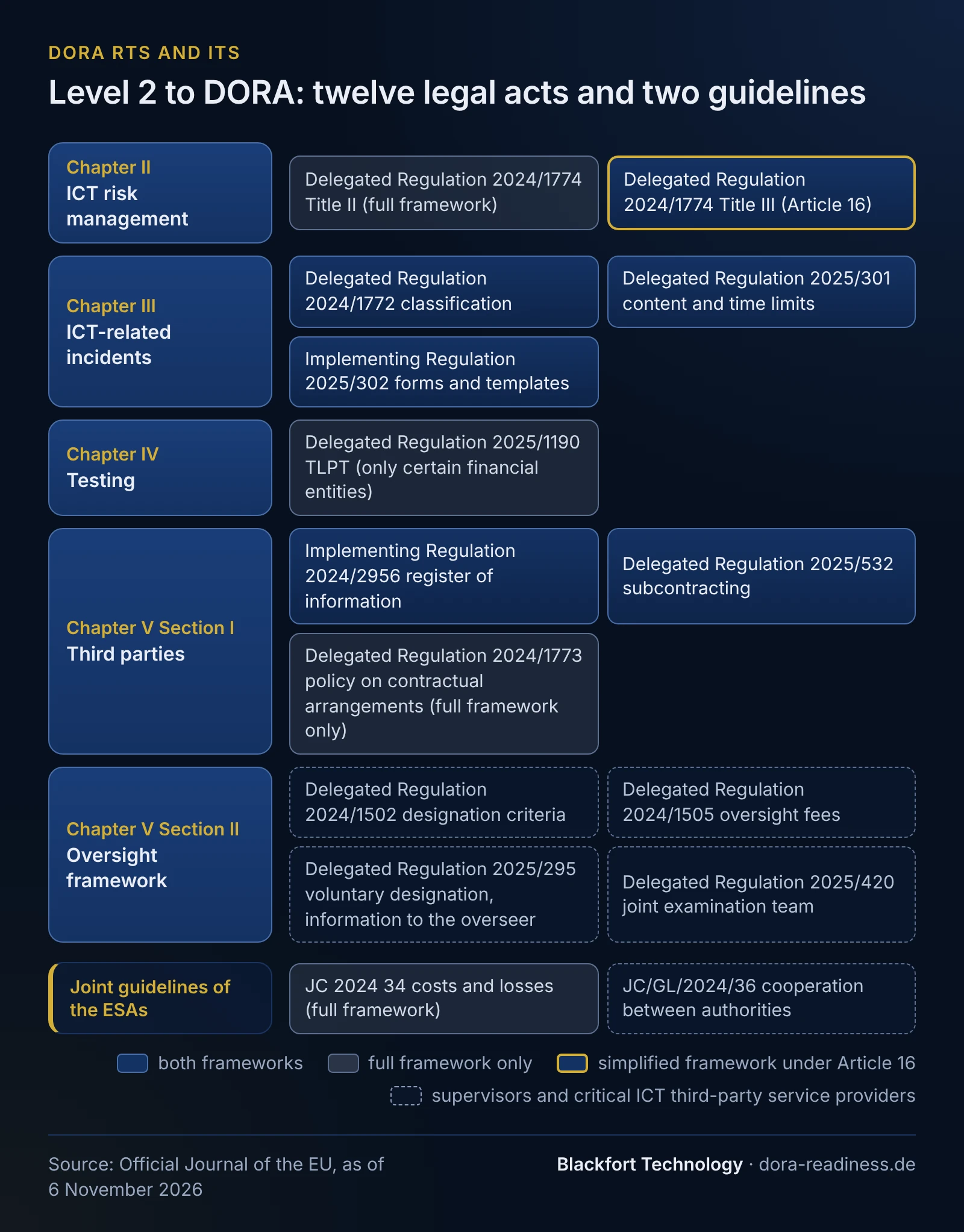
The map: all level 2 texts by DORA chapter
How to read the tables: “adopted” is the date of the act, “OJ” the date of publication in the Official Journal. “Basis” is the empowerment on which the act itself relies, as cited in its preamble. Article 20 has no numbered paragraphs, so the acts based on it cite it by position, as the third subparagraph or the fourth paragraph (the German version counts them as paragraphs 3 and 4). “KWG group” means the institutions under Section 1a(2a) of the German Banking Act (KWG), such as factoring and leasing firms. “Specifies” names the DORA articles whose obligations the act fills in. The number links to the German version on EUR-Lex, where the language can be switched.
Chapter II: ICT risk management
| Legal act | Adopted / OJ | Subject | Basis / specifies | Framework | More on |
|---|---|---|---|---|---|
| Delegated Regulation (EU) 2024/1774 (RTS) | 13 Mar 2024 / 25 Jun 2024 | tools, methods, processes and policies for ICT risk management, Title II (Articles 2-27), and the simplified framework, Title III (Articles 28-41) | Article 15 and Article 16(3) / Articles 5-15 (Title II), Article 16(1) (Title III) | Title II: full framework. Title III: Article 16 | ICT risk management, Article 16 |
Chapter III: ICT-related incidents
| Legal act | Adopted / OJ | Subject | Basis / specifies | Framework | More on |
|---|---|---|---|---|---|
| Delegated Regulation (EU) 2024/1772 (RTS) | 13 Mar 2024 / 25 Jun 2024 | classification of incidents and cyber threats, materiality thresholds, details of reports | Article 18(4) / Article 18(1) and (2) | both, KWG group since 17 January 2025 | Incident reporting |
| Delegated Regulation (EU) 2025/301 (RTS) | 23 Oct 2024 / 20 Feb 2025 | content and time limits of the initial notification, intermediate and final report, content of voluntary notifications of significant cyber threats | Article 20, third subparagraph / Article 19(4), Article 20, point (a) | both, KWG group since 17 January 2025 | Incident reporting |
| Implementing Regulation (EU) 2025/302 (ITS) | 23 Oct 2024 / 20 Feb 2025 | standard forms, templates and procedures for reporting | Article 20, fourth paragraph / Article 19, Article 20, point (b) | both, KWG group since 17 January 2025 | Incident reporting |
Chapter IV: Digital operational resilience testing
| Legal act | Adopted / OJ | Subject | Basis / specifies | Framework | More on |
|---|---|---|---|---|---|
| Delegated Regulation (EU) 2025/1190 (RTS) | 13 Feb 2025 / 18 Jun 2025 | threat-led penetration testing (TLPT): identification of financial entities, internal testers, scope, methodology, phases, cooperation between authorities, in line with the TIBER-EU framework | Article 26(11) / Articles 26, 27 | only financial entities under the full framework that the authority identifies, never Article 16 or microenterprises | Resilience testing |
Chapter V Section I: ICT third-party risk
| Legal act | Adopted / OJ | Subject | Basis / specifies | Framework | More on |
|---|---|---|---|---|---|
| Implementing Regulation (EU) 2024/2956 (ITS) | 29 Nov 2024 / 2 Dec 2024 | standard templates for the register of information | Article 28(9) / Article 28(3) | both, not for microenterprises of the KWG group | Register of information |
| Delegated Regulation (EU) 2024/1773 (RTS) | 13 Mar 2024 / 25 Jun 2024 | content of the policy on contractual arrangements for ICT services supporting critical or important functions | Article 28(10) / Article 28(2) | full framework only, without microenterprises, because Article 28(2) does not apply otherwise | ICT third-party risk |
| Delegated Regulation (EU) 2025/532 (RTS) | 24 Mar 2025 / 2 Jul 2025 | subcontracting of ICT services supporting critical or important functions | Article 30(5) / Article 30(2)(a) | both, not for microenterprises of the KWG group | ICT third-party risk |
Chapter V Section II: Oversight framework for critical ICT third-party service providers
| Legal act | Adopted / OJ | Subject | Basis / specifies | Framework | More on |
|---|---|---|---|---|---|
| Delegated Regulation (EU) 2024/1502 | 22 Feb 2024 / 30 May 2024 | criteria for designating ICT third-party service providers as critical: systemic impact, importance of the clients, critical or important functions, substitutability, sources of information | Article 31(6) / Article 31(2) | addressed to the ESAs as overseers | DORA for ICT providers |
| Delegated Regulation (EU) 2024/1505 | 22 Feb 2024 / 30 May 2024 | amount and payment of the oversight fees of critical ICT third-party service providers | Article 43(2) / Article 43(1) | critical ICT third-party service providers and the lead overseer | DORA for ICT providers |
| Delegated Regulation (EU) 2025/295 (RTS) | 24 Oct 2024 / 13 Feb 2025 | application for voluntary designation as critical, information from critical providers to the overseer, template for subcontracting arrangements, assessment of remediation measures | Article 41(2) / Article 41(1)(a), (b), (d) | ICT third-party service providers and authorities | DORA for ICT providers |
| Delegated Regulation (EU) 2025/420 (RTS) | 16 Dec 2024 / 24 Mar 2025 | composition, tasks and working arrangements of the joint examination team of ESAs and national authorities | Article 41(2) / Article 41(1)(c) | authorities only | DORA for ICT providers |
Joint guidelines of the ESAs
| Guideline | Adopted / applies from | Subject | Basis | Framework | More on |
|---|---|---|---|---|---|
| JC 2024 34 | applies from 19 May 2025 | estimation of the aggregated annual costs and losses caused by major ICT-related incidents, reported at the authority’s request | Article 11(11) / Article 11(10) | full framework without microenterprises, no such report foreseen under the Article 16 framework | Incident reporting |
| JC/GL/2024/36 | 6 Nov 2024 / 17 Jan 2025 | cooperation and information exchange between the ESAs and national authorities in the oversight framework | Article 32(7) | authorities only | DORA for ICT providers |
According to the ESAs’ compliance table, BaFin applies guideline JC 2024 34. On 6 November 2026, we did not find a separate list of adopted guidelines on BaFin’s website.
Which corrigenda affect the German text?
A corrigendum corrects the wording of one or more language versions and applies as if the text had been correct from the start. As with the column codes of the register of information, this can change what institutions submit. Anyone working with an older copy or an early extract reads the wrong wording. The Official Journal lists these four corrigenda for the German version:
| Corrigendum of | Legal act | Provision | What changes |
|---|---|---|---|
| 19 Dec 2024 | DORA | Article 6(8)(h) | The communication strategy relates to ICT-related incidents that must be disclosed under Article 14. Before, the German sentence read as if the strategy itself had to be disclosed. |
| 15 May 2025 | Delegated Regulation 2024/1774 | Article 22, first subparagraph, point (d) | Retention of evidence on incidents refers to Article 8(2) of Delegated Regulation 2024/1772 instead of its Article 15 (all language versions). |
| 3 Jul 2025 | Delegated Regulation 2025/1190 | Article 9(6) | “Testmanagern” (test managers) instead of “Testleitern” (test leads) in the German text. |
| 19 Sep 2025 | Implementing Regulation 2024/2956 | Annex I, templates B_05.01, B_06.01, B_07.01 | The type of code for the provider is given directly (LEI, EUID, CRN, VAT, PNR, NIN) instead of as a country code with an underscore. The column codes of the function template B_06.01 from the criticality assessment onwards move up by one number (B_06.01.0050 to 0100 instead of 0060 to 0110). Plus two minor corrections (all language versions). |
Other corrigenda only affect other language versions, for example the French version of the reporting regulations 2025/301 and 2025/302.
Example: Muster-Factoring GmbH filters the map
Fictitious example, not a client. Muster-Factoring GmbH (23 staff, EUR 61 million total assets) applies the simplified framework under Article 16 from 1 January 2027, and incident reporting since 17 January 2025 (Section 1a(2a) in conjunction with Section 65a(3) KWG). For its register of applicable rules, the compliance officer goes through the map row by row:
| Legal act | Result for Muster-Factoring GmbH | From |
|---|---|---|
| 2024/1774 | apply Title III (Articles 28-41), not Title II | 1 Jan 2027 |
| 2024/1772, 2025/301, 2025/302 | apply. Whether Article 8(2) of Delegated Regulation 2024/1772 applies to the KWG group is an open question, explained on the page Incident reporting | since 17 Jan 2025 |
| 2024/2956, 2025/532 | apply, because the institution is not a microenterprise | 1 Jan 2027 |
| 2024/1773 | do not apply, Article 28(2) does not apply under the Article 16 framework | - |
| 2025/1190 | do not apply, no TLPT under the Article 16 framework | - |
| 2024/1502, 2024/1505, 2025/295, 2025/420, JC/GL/2024/36 | no obligations of its own, for information on the oversight framework only | - |
| JC 2024 34 | do not apply, no report of costs and losses foreseen under the Article 16 framework | - |
The result is six legal acts with official reference, status and corrigenda in the register of applicable rules. For the internal policies, the compliance officer decides that they will only cite the version published in the Official Journal from now on. Which obligations follow in detail is shown in the obligations matrix and on the page on Article 16.
Three typical gaps in handling level 2
| Gap | Cause | Effect | Remedy |
|---|---|---|---|
| Draft cited instead of Official Journal | Many implementation projects started in 2023 and 2024 with the ESAs’ final reports, before the Commission had adopted the acts. | Policies refer to draft numbers. Places where the adopted version differs go unnoticed. | Switch all references to the Official Journal version with number and date, and read the affected sections once against the adopted text. |
| Corrigenda not followed up | Corrigenda appear as separate documents in the Official Journal and are missed when the texts are filed only once. | Completion guides and policies work with outdated wording, for example with the old column codes of the function template B_06.01 in the register of information. | Record for each act in the register of applicable rules whether corrigenda exist, and check the status at every review of the register (our recommendation). |
| Oversight acts read as a source of obligations | All twelve acts supplement DORA, but they are addressed to different parties. | Financial entities or providers build processes for fees, examination teams or designation criteria that are aimed at the supervisors or at providers designated as critical. | Note the addressee for each act. Only the supervisors designate a provider as critical. |
How we help
We compare your policies and evidence with the level 2 texts that apply to your framework and record reference and status. The starting point is the DORA gap analysis. Institutions of the KWG group moving from BAIT to the simplified framework on 1 January 2027 find the matching service in our transition from BAIT.
Frequently asked questions
Which version do we cite in internal policies?+
What is the difference between an RTS and a delegated regulation?+
Does Delegated Regulation 2024/1774 apply in full to institutions under Article 16?+
Are the ESA guidelines binding on us?+
Where can I find the official texts?+
Read more
- DORA regulation (EU) 2022/2554: structure, dates, supervision
- DORA requirements: obligations matrix for the full framework and Article 16
- DORA Article 16: the simplified ICT risk management framework
- ICT risk management under DORA: framework and DOR strategy
- DORA register of information: structure, mandatory fields, submission
- ICT third-party risk under DORA: managing providers and Article 30 contracts
- DORA incident reporting: classifying and reporting ICT-related incidents
Sources
- Regulation (EU) 2022/2554 (DORA), Articles 11, 15, 16, 18, 20, 26, 28, 30, 31, 32, 41, 43, German version (retrieved 2026-11-06)
- Corrigendum of 19 December 2024 to Regulation (EU) 2022/2554 (German version) (retrieved 2026-11-06)
- Delegated Regulation (EU) 2024/1774 and corrigendum of 15 May 2025, German version (retrieved 2026-11-06)
- Delegated Regulation (EU) 2024/1772, German version (retrieved 2026-11-06)
- Delegated Regulation (EU) 2025/301, German version (retrieved 2026-11-06)
- Implementing Regulation (EU) 2025/302, German version (retrieved 2026-11-06)
- Delegated Regulation (EU) 2025/1190 and corrigendum of 3 July 2025, German version (retrieved 2026-11-06)
- Implementing Regulation (EU) 2024/2956 and corrigendum of 19 September 2025, German version (retrieved 2026-11-06)
- Delegated Regulation (EU) 2024/1773, German version (retrieved 2026-11-06)
- Delegated Regulation (EU) 2025/532, German version (retrieved 2026-11-06)
- Delegated Regulation (EU) 2024/1502, German version (retrieved 2026-11-06)
- Delegated Regulation (EU) 2024/1505, German version (retrieved 2026-11-06)
- Delegated Regulation (EU) 2025/295, German version (retrieved 2026-11-06)
- Delegated Regulation (EU) 2025/420, German version (retrieved 2026-11-06)
- ESAs: Joint Guidelines JC 2024 34 on the estimation of aggregated annual costs and losses, with compliance table (retrieved 2026-11-06)
- ESAs: Joint Guidelines JC/GL/2024/36 on oversight cooperation and information exchange (retrieved 2026-11-06)
- BaFin: DORA FAQ, question 11 (no rule-making power of its own), in German (retrieved 2026-11-06)
- Official Journal of the EU: SPARQL endpoint of the Cellar database (query for legal acts based on DORA and corrigenda) (retrieved 2026-11-06)
This content provides general technical and organisational information and does not constitute legal advice (no legal services within the meaning of the German RDG).