

Last updated: 2026-11-06
This page covers the full framework under Articles 5 to 15 of DORA, for example CRR credit institutions, insurance undertakings and fund management companies. Which framework applies to you is explained on the page DORA applicability. For institutions in the simplified framework under Article 16, a section further down shows what remains.
Where does DORA mention the ICT reference architecture?
In Article 6(8)(d). It is often attributed to Article 8, but the legal text uses the term only in this one place: the digital operational resilience strategy (DOR strategy) includes methods to address ICT risk and attain specific ICT objectives by “explaining the ICT reference architecture and any changes needed to reach specific business objectives”. The German version says the same. Delegated Regulation (EU) 2024/1774 (the RTS) does not use the term.
There is no definition. BaFin points out that the term is new in DORA and not defined in Article 3, so that the boundaries may be blurred. It considers the requirement comparable to the strategic development of the IT architecture under chapter 1.2(d) of the BAIT and VAIT (BaFin supervisory notice of 8 July 2024, section 1.1, in German). Because the reference architecture is part of the DOR strategy, the management body sets and approves it together with the strategy (Article 5(2)(d)). What else the DOR strategy must contain is shown on our page ICT risk management under DORA.
What does Article 8 DORA require?
Article 8 governs identification: functions, assets and dependencies are identified, classified, documented and kept in inventories. Information assets are collections of information, tangible or intangible, that are worth protecting. ICT assets are software or hardware assets in the network and information systems (Article 3(6) and (7)).
| Paragraph | Requirement | Frequency | Microenterprises |
|---|---|---|---|
| (1) | identify, classify and document ICT supported business functions, roles and responsibilities, the supporting information and ICT assets and their roles and dependencies | review the classification as needed, at least yearly | applies |
| (2) | identify sources of ICT risk continuously, assess cyber threats and vulnerabilities | review risk scenarios at least yearly | applies |
| (3) | risk assessment upon each major change in infrastructure, processes or procedures | event-driven, on each major change | does not apply |
| (4) | identify all information and ICT assets, including remote sites, map those considered critical, map configuration and the links and interdependencies | via (6) | applies |
| (5) | identify and document processes that depend on ICT third-party service providers, identify interconnections with providers supporting critical or important functions | via (6) | applies |
| (6) | maintain inventories for (1), (4) and (5) | periodically and on every major change | applies |
| (7) | specific ICT risk assessment of all legacy ICT systems | at least yearly, before and after connecting new technologies | does not apply |
Articles 4 and 5 of the RTS add detail. The ICT asset management policy covers the lifecycle and prescribes the records to keep for each ICT asset (Article 4(2)(b)(i) to (ix), example below). The procedure under Article 5 sets the criteria for assessing the criticality of assets: the ICT risk of the supported functions and the impact of a loss of confidentiality, integrity and availability. Which functions are critical or important you decide using the method on our page Classifying critical or important functions.
How do the reference architecture and the inventories fit together?
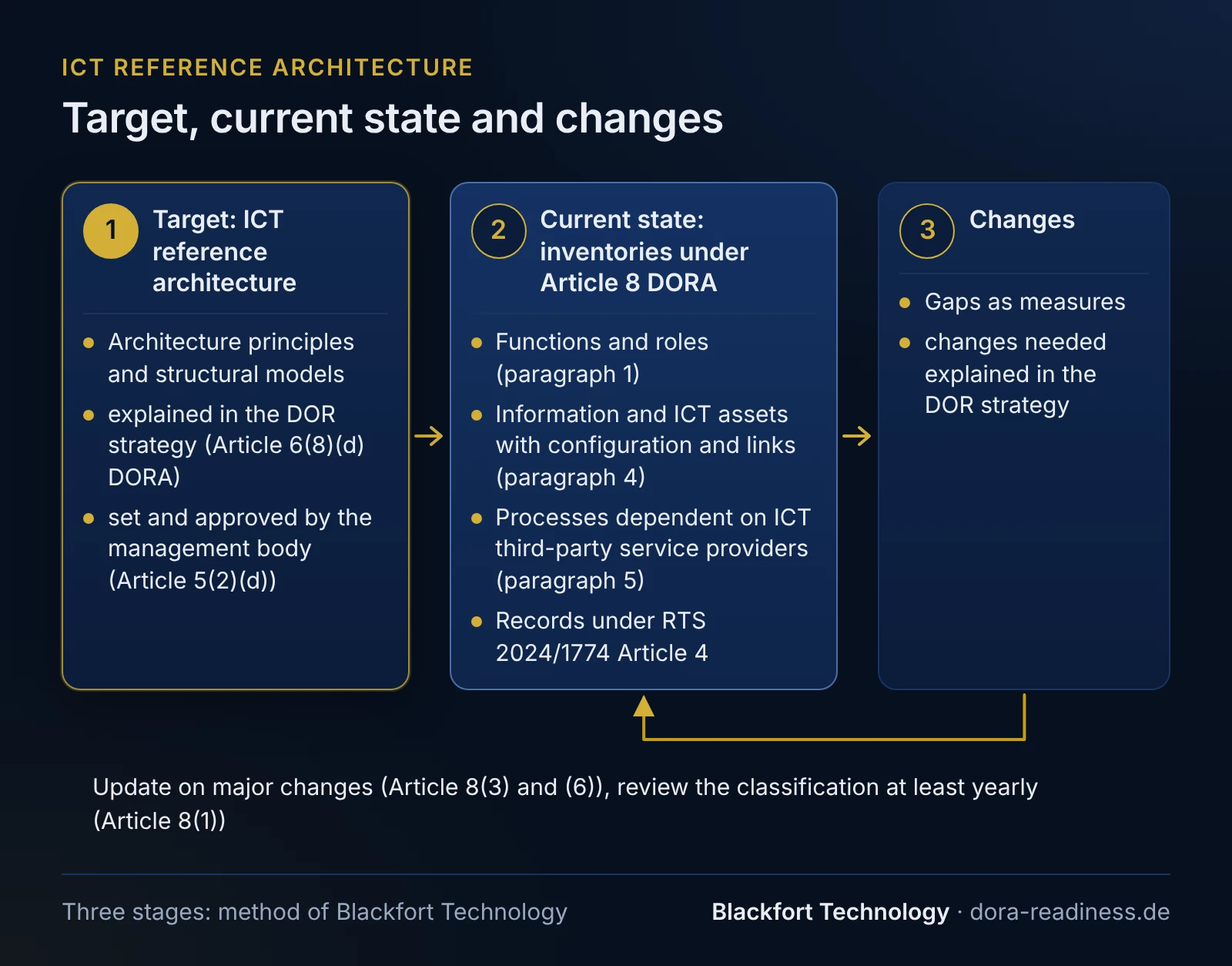
The reference architecture is the target, the Article 8 inventories are the current state. Point (d) requires both to be considered together, because the DOR strategy has to explain the changes needed to reach business objectives. Those changes follow from comparing target and current state. We therefore work in three stages:
- Target: architecture principles and structural models that set how ICT should be built. Independent of products, so that it does not age with every purchase.
- Current state: the inventories under Article 8(6) with functions, assets, configuration, links and providers.
- Changes: each gap becomes a measure with rationale, priority and owner. The DOR strategy explains the major ones.
DORA prescribes no method. BaFin describes DORA as standard-neutral, and the RTS only asks for leading practices and, where applicable, standards to be taken into account (RTS Article 2(2)(h)). We use terms from the TOGAF Standard of The Open Group as our method (TOGAF is a trademark of The Open Group): target architecture, baseline architecture and architecture principles. A TOGAF certification or a TOGAF project is not needed for this.
What belongs in an ICT reference architecture?
DORA does not set the content. Our professional recommendation is two levels in one document:
Architecture principles are lasting rules for planning, procurement and operations, each with name, statement and rationale. Examples are identity-based access instead of trust based on network position (often called “zero trust”), security as a design criterion from the start, several independent layers of protection, coupling of systems only through documented interfaces, and a defined operating model for cloud services. DORA prescribes none of these principles. They help, however, to meet the RTS requirements over time.
Structural models describe the build at conceptual and logical level, without products, versions or IP addresses. In the full framework several of them have an anchor in Delegated Regulation (EU) 2024/1774:
| Structural model | What it sets | Anchor in RTS 2024/1774 |
|---|---|---|
| Zone and segmentation model | network zones by criticality of functions, separate network for administration, controlled links to the internet | Article 13(a), (c), (g) |
| Communication model | encryption between zones and to the outside, documented connections and data flows | Article 13(b), (e) |
| Identity and access model | central identities, privileged access only on a need-to-use or ad hoc basis | Article 21(e)(ii) |
| Resilience classes | which categories of functions run redundantly and which recovery objectives apply | Article 24(1)(a)(i), (b)(ii) (objectives per function under Article 12(6) DORA) |
| Provider model | which services may be sourced externally and under which conditions | Article 8(5) DORA, Article 28 DORA |
The network architecture and the network security design are to be reviewed once a year, periodically for microenterprises (RTS Article 13(i)). How privileged access is controlled technically is shown on our company page on privileged access under DORA.
Test for each statement: does it describe a lasting principle or pattern, independent of products? Then it belongs in the target. Does it describe a current state, a product or a configuration? Then it belongs in the inventory.
Example: reference architecture of Muster-Kreditbank AG
Fictitious example, not a client. Muster-Kreditbank AG is a CRR credit institution with 140 employees. Its core banking system is run by a data centre provider, workplaces and network by a managed service provider (MSP). Its reference architecture has this structure, each component mapped to the legal references and to the inventories:
| Component | Content at Muster-Kreditbank | Reference | Link to the Article 8 inventories |
|---|---|---|---|
| 1 Scope and business link | all systems of the bank and its providers for lending, deposits and payments, link to the business strategy 2027-2029 | Article 6(8)(a), (d) | function inventory (paragraph 1) as structure |
| 2 Architecture principles | five principles with name, statement, rationale | Article 6(8)(d), our recommendation | deviation noted per asset in the inventory |
| 3 Zone model | four zones: internet gateway, applications, data, administration network | RTS Article 13(a), (c) | zone as a mandatory field per asset, exposure to external networks (RTS Article 4(2)(b)(vii)) |
| 4 Communication model | only encrypted connections between zones and to the outside, exceptions by decision | RTS Article 13(b), (e) | links and interdependencies (Article 8(4), RTS Article 4(2)(b)(viii)) |
| 5 Identity and privileged access | one directory service, admin access only through an access platform with logging | RTS Article 21(e)(ii) | owner per asset (RTS Article 4(2)(b)(iv)) |
| 6 Resilience classes | class A redundant in two data centres, class B restore from backup, class C fallback procedure | Article 12(6) DORA, RTS Article 24 | recovery objectives per asset (RTS Article 4(2)(b)(vi)) |
| 7 Provider model | data centre and workplace operations may be external, key management stays internal | Article 8(5), Article 28 DORA | processes dependent on providers (paragraph 5), reconciled with the register of information |
| 8 Lifecycle and legacy systems | systems only with vendor support, legacy systems with a replacement date | Article 8(7) DORA, RTS Article 4(2)(a), (b)(ix), (c) | end of support per asset, legacy assessment |
| 9 Changes needed | replacement of the legacy collateral system by 2028, administration network by 2027 | Article 6(8)(d) | derived from the deviations in the inventory |
| 10 Maintenance and approval | drafted by IT architecture, approved by the management board together with the DOR strategy | Article 5(2)(d), Article 6(5) | classification reviewed at least yearly (Article 8(1)), inventories on major changes (paragraph 6) |
One entry in the bank’s asset inventory holds the records from RTS Article 4(2)(b):
| RTS Article 4(2)(b) | Example entry |
|---|---|
| (i) unique identifier | APP-0417 |
| (ii) physical or logical location | provider’s data centre, application zone |
| (iii) classification | critical, confidentiality high, integrity high, availability high |
| (iv) owner | head of lending |
| (v) supported functions | credit decision and disbursement |
| (vi) business continuity requirements | resilience class B, recovery time objective 24 hours, recovery point objective 4 hours |
| (vii) exposure to external networks | yes, customer portal via the internet gateway |
| (viii) links and interdependencies | core banking system, credit bureau interface, directory service |
| (ix) end of vendor support | regular 12/2029, extended 12/2031 |
The recovery objectives match the BIA shown for the same bank on our page ICT risk management.
What applies in the simplified framework under Article 16?
A reference architecture is not an explicit requirement there. BaFin finds neither the requirement of Article 6(8)(d) nor the strategic development of the IT architecture under BAIT 1.2(d) in the simplified framework (supervisory notice of 21 August 2025, section 2.1, in German), and the yearly legacy assessment under Article 8(7) is not required (section 4.1). Identification remains: critical or important functions, the supporting information and ICT assets and their interdependencies must be identified, classified and documented (RTS Article 30(1)), as must the functions supported by providers and the key dependencies on ICT third-party service providers (RTS Article 30(2), Article 16(1)(e) DORA). BaFin does not require a CMDB for this (section 3.1). The other obligations are covered on the page Article 16 DORA.
Three typical gaps
| Gap | Cause | Effect | Remedy |
|---|---|---|---|
| Inventory without links | The inventory comes from a licence list and a network scan and counts devices and programs. | Configuration, links and interdependencies are missing (Article 8(4), RTS Article 4(2)(b)(viii)). Which function an outage hits remains unclear. | Keep the supported functions and connected assets as mandatory fields per asset, starting from the critical or important functions. |
| Target without a path | The reference architecture exists as an IT slide, the DOR strategy only refers to it. | The explanation of changes needed under Article 6(8)(d) is missing, the management body approves a picture without consequences. | Track gaps between target and inventory as dated measures and explain the major ones in the DOR strategy. |
| End of support not recorded | The inventory knows versions but no end dates of vendor support. | RTS Article 4(2)(b)(ix) is not met, legacy systems only surface with the next vulnerability. | Record end dates per asset and link them to component 8 (lifecycle) and the yearly legacy assessment. |
How we help
We develop the target with you, compare it with your Article 8 inventories and derive the changes needed for the DOR strategy. If you first want to know where your framework stands as a whole, we start with the DORA gap analysis.
Frequently asked questions
Does the ICT reference architecture have to be a separate document?+
Do we need a CMDB for the inventories?+
How often must the reference architecture be updated?+
Do Article 8 and Article 6(8)(d) also apply to microenterprises in the full framework?+
Read more
- ICT risk management under DORA: framework and DOR strategy
- Classifying critical or important functions under DORA
- DORA register of information: structure, mandatory fields, submission
- ICT third-party risk under DORA: managing providers and Article 30 contracts
- DORA Article 16: the simplified ICT risk management framework
- DORA gap analysis: quick check, Article 16 and full framework
Sources
- Regulation (EU) 2022/2554 (DORA), Article 3(6) and (7), Article 5(2)(d), Article 6(5) and (8), Article 8, Article 16(1)(e) (retrieved 2026-11-06)
- Delegated Regulation (EU) 2024/1774 (RTS on ICT risk management), Article 2(2)(h), Articles 4, 5, 13, 21, 24, 30 (retrieved 2026-11-06)
- BaFin: supervisory notice of 8 July 2024 (as of June 2024) on implementing DORA in ICT risk management and ICT third-party risk management, section 1.1 (German) (retrieved 2026-11-06)
- BaFin: supervisory notice of 21 August 2025 on implementing DORA with the simplified ICT risk management framework (Article 16 DORA), sections 2.1, 3.1, 4.1 (German) (retrieved 2026-11-06)
- The Open Group: The TOGAF Standard (overview page). TOGAF is a trademark of The Open Group. (retrieved 2026-11-06)
This content provides general technical and organisational information and does not constitute legal advice (no legal services within the meaning of the German RDG).